Oct 14, 2011

NYFF 2011: Martha Marcy May Marlene


I just adore movies where evil happens in plain daylight. I have not felt so creeped out by a movie in a long time. Writer-director Sean Durkin's extraordinary film is a psychological horror story about Martha, the outstanding Elizabeth Olsen (sister of the celebrity twins), in a breakthrough performance, who escapes from a cult and goes back to her affluent sister Lucy (Sarah Paulson, also excellent). As she starts a new life at her sister's, certain innocuous moments trigger traumatic memories in her, and the movie goes back and forth seamlessly between the present and her life in the cult.
The cult at first looks like a naive commune of hippies, led by Patrick, a scrawny, not particularly charismatic guy (John Hawkes). But the bizarreness and the menace of controlled chaos, seep in instantly. People sleep huddled together on mattresses on the floor, the men eat first as the women wait (starving people is one method of mind control), people share clothes and supposedly try to start up a farm, but it is not clear how they make a living.
Patrick has an emissary (creepy Brady Corbet) who brings lost young women from nearby towns. They are received warmly, and at first it seems like a cool place to chill out from the demands of reality. Martha arrives because her good friend Zoe is already there. Durkin lets the details of life in the cult trickle steadily and become more and more disturbing as Martha becomes more unhinged at her sister's house. Durkin and his editor sustain the double helix of the structure with great fluidity, as they let the creepiness accrue without hurry. We see the daily dismantling of self at the cult, but to watch Martha being unable to behave normally once she is safe, is just as fascinating. She has been brainwashed out of the most basic social behaviors, and, as she does not confide in her sister, she and her husband have no idea why she acts so strange. She says she broke up with a boyfriend with whom she was living in the Catskills, something that seems to horrify her sister. It is completely believable that it would never occur to them that she has been in a cult. They know nothing about her.
Besides being a chilling trip into the dangers of falling victim to a cult, which for my taste is scarier than vampires, zombies, or ghosts, the movie is also about American social disconnection, which is also scary as hell. Martha has not been in touch with her sister, her only surviving family member, for two years. Magnificent Arepa and I were saying that if Martha were a Latina, she would not have lasted 2 days without her entire family going on a search and rescue mission. In the US, you are on your own: that's the American way. It is common for people to drift out of society. In the end, the lost souls who end up in bizarre cults are looking for an alternate family, and Patrick, an incestuous father figure, a serial sexual abuser, couches life in the cult in those familial terms. Through a hodgepodge philosophy of so-called freedom and enforced communal life, Patrick strips his charges from their moral bearings and their willpower, besides drug-enabled sex and other nasty mind games. Nobody ever stops around the cult compound to check it out. Evil can flourish undisturbed where nobody cares for their neighbor.
Lucy is married to a wealthy New York City architect (Hugh Dancy), and Martha stays at their country retreat in Connecticut, so spacious that Martha questions, not without a point, why two people need to have such a big place. The wealthy married couple are classic strivers, they want to have kids, they work their asses off and they enjoy the fruits of their wealth. They may be egotists, but they have functional egos. Cults deprive you of your ego in the positive sense of the word: they strip away who you are, your values, your integrity. Martha seems to have kept what little ego she had before she arrived at the cult: as opposed to others who are completely brainwashed, she bristles at incidents of cruelty, and there is a part of her that Patrick psychopathic ego can't touch, which is why she escapes.
Durkin's successfully expresses Martha's sensation of not knowing where she is, where she is waking up, how much time has elapsed, how close or far places are from each other, yet, this intelligent, disciplined film makes sure the audience always knows what's happening, even as we share Martha's disorientation. As far as I'm concerned, the chilling ending is what turns this movie, which could pass as a psychological drama up to that point, into a quietly devastating horror film.
The more I think of Martha Marcy May Marlene, the more it gives me the shivers.
It's a wonderful feeling.

Oct 11, 2011

NYFF 2011: Shame


The fruitful collaboration between director Steve McQueen (Hunger) and actor Michael Fassbender is starting to resemble Scorsese's with De Niro. Shame, their second foray together, is also about the mortification of the flesh but for opposite reasons to Hunger. Brandon, the protagonist of Shame, is far from a religious-political martyr who sacrifices himself with fearless discipline for a cause; he is a sex addict. Handsome, successful by the New York definition (he owns his apartment and has a job), he cannot control his sexual urges. He uses sex like other people abuse drugs. He masturbates in the office, watches porn there and at home, spends probably half his salary on expensive whores, and cannot stop. As is to be expected, this man whose mind is mired in filth, is an obsessive neat freak. His world is all smooth surfaces, steely blues and grays. He looks like money and women fall for him (who wouldn't?). The promise of sex with him sounds tantalizing, but just as he is mysteriously attractive, he is disgusting. He is disgusted with himself for being disgusting, so he goes deeper into more disgust.
The opening shot of this movie is Fassbender lying naked in bed, blue sheets covering his groin, looking like a supine Christ in a renaissance painting. McQueen is a renowned visual artist and, as in Hunger, every frame of this movie is masterfully composed and some are reminiscent (or is it just me?) of classic painting motifs, like pietas and annunciations. But the controlled aesthetics are in counterpoint to visceral emotions, and as in Hunger, McQueen does not shy away from the visceral. He doesn't go for the overly graphic either. He does not confuse that kind of shock value with art, as other more pretentious auteurs do (I'm thinking Bertolucci or Vincent Gallo's The Brown Bunny). The shock here comes from Brandon's terrible psychic pain and his joyless debasement of his body. Fassbender gives a brave and incredible, almost silent performance as a guy who is fighting with all his being against feeling emotional pain, by compulsively, almost suicidally seeking the release of sexual pleasure, but without the intimacy of human connection. It is a miracle he can keep this perverse act of self-loathing going on for as long as he does. I guess being a white male with money helps.
A woman leaves insistent messages on Brandon's phone. He never picks up. He works at a cold and angular job, all male assholes at the top, for a garrulous married boss that tries too hard to pick up women. Brandon, in contrast, vanquishes them like flies just by deploying devastating come hither looks. He can have any woman he wants in New York (including me). So why use whores? Why watch porn? Because sex is a wonderful way to feel everything but pain. It is a wonderful way to feel debased. He is self-medicating his shame with more of the same.
Spoiler alert, plot details ahead:
One day he comes home from yet another zipless fuck, as Erica Jong would say, to find music blaring from his stereo (the song: Chic's I Want your Love). He takes a baseball bat and bursts into the bathroom, where a woman (the excellent Carey Mulligan) is taking a shower. The framing of this scene reminded me of a Giotto annunciation. She reminds him she had keys. She is an emotional wreck with a bad dye job. Probably nothing thwarts a sex addict more than an unwanted house guest; even worse, a close relative. Later, we figure out that Sissy is his sister, but this is not a "here comes the Flying Nun to set her brother straight" story. She is a mess; a cabaret singer, with traces of self-inflicted damage on her wrists. These two are extremely damaged goods, from across the river in Jersey, which appears in the distance in several scenes, (as if the brother and sister had crossed the river Styx and still could not get rid of all that pain), and prior to that, Ireland. Probably Catholics, hence even more shame. At one point she says, "we come from a bad place, but we are not bad people". This is explanation enough. McQueen is not one for the American confessional mode. The point of shame is guilt and secrecy, not spilling the beans to anyone who will listen.
In contrast to her brother, Sissy expresses her pain by singing, (meaning: by being an artist) and by wallowing in big emotions. She embraces her mistakes so hard she almost smothers them with love. But she doesn't even have a roof over her head and asks to stay with Brandon for a while. She sleeps on the couch and Brandon can hear her, over the heavy breathing of his internet porn, crying and desperately begging a boyfriend to take her back, debasing herself for love and attention: it seems to be the family way. But does he go out and comfort her? Hell, no. He is at once heartbroken and disgusted.
At a nightclub, in the presence of her brother and his boss, Mulligan, photographed in a warm, golden light, sings the most depressing, ironic cover of "New York, New York". It may be her commentary on her own failure to achieve success (although if she made it to a swanky bar that takes reservations, she can't be so shabby), or on her brother's unconvincing veneer of success. He may fool everyone else, but he doesn't fool her. He sheds a tear when he hears her sorrowful voice, but is cold and stingy with his praise. His boss, however, charms her with deserved admiration, and soon she is fooling around with him in Brandon's bed. This is like taking the last baggie on Earth away from a desperate cokehead. He is furious: it disgusts him that she slept with his boss, and he knows this is the pretext he can use to ask her to leave, but he won't admit that she took over his space and now he cannot abuse himself in peace. She comes into his bed later to patch things up, but aware of his unbearable urges, he banishes her from his bedroom. Fassbender won the acting prize in Venice and is a huge contender for the big acting awards coming up. He embodies coherently and fearlessly the extreme contradictions in Brandon's character.
Brandon, unwilling to recognize his problem, just keeps getting worse. The fact his sister is there does not clean him up; it makes him feel even dirtier. His computer at work is taken and a massive cache of hardcore porn is found in the hard drive. His boss tells him that "whoever" put it there is a sick fuck. I guess this being a boy's club, they'd rather keep Brandon, who seems to be good at his job, even though he is always late, than fire him. Brandon feigns ignorance and just walks out of the room. Still, while Sissy lives with him, he goes on a date with a co-worker (Nicole Beharie, wonderful). He makes an effort. The date scene is intimate and awkward, and the waiter, armed with the pretentious spiel of most New York restaurant waiters, keeps interrupting the flow of a painfully labored conversation, and making it worse for Brandon, who is having a hard time trying to seem normal. He really likes this woman and leaves her hanging on the first date with nary a kiss good night. Lo and behold, he controls himself. This does not last long. In the office, on a whim, he takes her to the Standard Hotel (a good example of successful product placement, for once) in the meatpacking district, for a quickie. Unsurprisingly, he can't perform with her. Worse, he treats her like he treats his whores. The answer to which is even more debasement.
McQueen knows how to handle dramatic scenes, and he is a great director of actors. The key confrontation between brother and sister is shot in close up from the back, as the siblings sit side by side on Brandon's couch. She asks him to hug her and this unleashes a torrent of hissing cruelty from him. This scene is far more wounding than if it had been shot showing the actors arguing from the front. Mulligan's extraordinary work in this movie should also be recognized come awards time. I didn't know she had it in her to be so raw.
The third act is Brandon's spiral descent into hell. On his long dark night of the soul, Brandon looks for ways to hit bottom, one of which is to have a paid threesome. The music is Glenn Gould playing Bach, what Brandon hears in his iPod to calm his battered soul. But how does a serious film portray images of sex? The originality lies in that the scene, shot in an arty way that looks like what porn would look like if it had better lighting and a good cinematographer (in this case, Sean Bobbitt, who also shot Hunger), happens to be dramatically the lowest point of Brandon's existence. In contrast to porn, which refuses to acknowledge human feelings, this extended sexual sequence is there to portray the soul of a man in torment. The scene ends with Brandon's face striving painfully for the obliteration of orgasm and becoming monstrous, deformed.
The movie ends with a terrible catharsis. It takes something much worse than what Brandon has been avoiding all along, to make him come out on the other side.
I really liked Shame, but there is something about McQueen's disciplined style that I find confounding. This movie is about extreme emotions, but something feels cold at its core.


Oct 9, 2011

NYFF 2011: Melancholia


My original review of this latest film by Lars Von Trier went like this:
"Wow".
But I owe it to my readers to provide slightly more illumination, so here goes:

My theory about Von Trier is that he is a madman with creative visions and what we have been getting from him lately are personal working outs of his inner demons on film. His first features were not about him, but about selfless love and Christian-like sacrifice, but lately he is using imagery to express a state of mind. Antichrist struck me as a petulant tantrum of self-indulgent excess: the artist in the midst of a nervous breakdown; whereas Melancholia, an exploration into the depths of depression, feels like the gift of an artist who has made peace, of sorts, with his demons. I don't think there is or will ever be a movie that depicts depression so accurately, so sensually and with such understanding as this one.
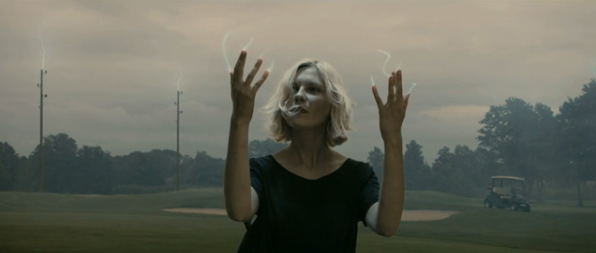
The movie starts with a stunning sequence of astonishingly beautiful images, accompanied by Wagner's Prelude to the Liebestod of Tristan and Isolde (in a nutshell, love and death, a major theme of the movie). Like Terrence Malick with The Tree Of Life, Von Trier proves that digital imaging can be used to extraordinary artistic effect in movies, not just for chases and explosions. Here, there are gorgeous shots of planets in the sky, strange visions of more than two moons, an orb coming towards Earth, as we see Kirsten Dunst dressed as a bride running in the mud, Charlotte Gainsbourg holding a small child across a sinking golf course, a horse falling in the forest, all in extreme slow motion. The extraordinary cinematography with the digital Alexia and Phantom cameras is by Manuel Alberto Claro.
Then the title comes in: not plain Melancholia, but Lars Von Trier's Melancholia.
Enter at your own risk.
I have a feeling that if Von Trier had not opened his big, idiotic mouth at Cannes, the Palme D'Or would have been his. Melancholia makes The Tree Of Life look like a Hallmark card. In the end, both movies are about grace, but Malick has a much more luminous, new-agey, faith-based view of life. Von Trier's film is about apocalyptic depression. No religion involved.
Opening scene: a ridiculously long white limousine gets stuck in one of the bends of a narrow country path. Inside are a beautiful bride, Justine (Dunst) and an even more beautiful groom (Alexander Skarsgard). It is a funny scene, as the bride and the groom, stressed out at being late to their own wedding, realize the humor of the situation and sweetly help the driver steer the wheel. Finally, they arrive at a gorgeous manor in what must be Vontrierland, because it sounds like it could be the US, except half the people are from Europe. Wherever it is, it looks like a fairy tale, a semi-castle with manicured grounds and an 18-hole golf course, property of John (Kiefer Sutherland, excellent) and his wife Claire (Charlotte Gainsbourg). Claire is Justine's sister, even if they don't look anything alike and have completely different accents. Their parents are played by John Hurt, an old rascal who brings two women called Betty to the wedding; and a brittle, monstrous Charlotte Rampling as the mother of the bride from hell. So hellish is she, that she wears a tie dye shirt to the wedding, no makeup. John and Claire are furious because this extravagantly expensive wedding is going down the tubes fast. Udo Kier, almost having a nervous breakdown himself, plays the wedding planner. Fun!
Justine, having arrived at her own wedding two hours late, first has to go to the barn to say hi to her favorite horse. This is not the most auspicious beginning for a bright future (these people are loaded, they have not a care in the world). But the bride is dreamy and distracted, almost narcoleptic. She regularly abandons key moments in the meticulously planned ritual, like the cutting of the cake or the throwing of the bridal bouquet, to jump onto a golf cart or take a bath, saintly groom and wedding party be damned. Something is not right with this lovely young woman, and the way Von Trier depicts the superhuman effort she makes to make it seem like she's there, like she is happy, like she appreciates what people do for her, is harrowing and heartbreaking. Justine cannot get away from the pull of Melancholia. She is awash in depression. This makes her act erratically, and she can be sweet and unfathomably sad and fragile, but also irrational, inconsiderate and bratty. The only note that struck me as false in Justine's story was her relationship with her boss (Stellan Skarsgard). Apparently, she is a genius copywriter and right at the wedding he gives her a promotion, turning her instantly into an art director (as if!), as long as she comes up with "a tagline" that very night. He sics a young man (a good Brady Corbet) to pry the tagline out of her, apparently knowing that her precarious state of mind is conducive to bursts of brilliance. This is fake and absurd, but I assume it is meant to signify that Justine is a creative being, like the film's director.
The second half of the film is devoted to Claire and deals with the anguish she has at the prospect of the world ending tomorrow. As it happens, Melancholia is also a planet that is orbiting Earth and is predicted to come extremely close to it. Claire is afraid Melancholia is going to crash against Earth, and the scientific assurances of her husband do little to assuage her, for Claire has a young son and she fears for his future. Justine appears at Claire's home one day, barely capable to get in and out of a cab, sans husband. Claire takes care of her, with the help of her majordomo, a character improbably named Little Father and played with surly aplomb by Jesper Christensen (the Nazi from The Debt). Ridiculous in a classic Von Trierish way.
Since we are in high symbolism territory, the two sisters are opposites in looks and outlooks alike. Claire is a doer, a planner, a homemaker (perhaps she represents the practical side of Von Trier that allows him to direct films). Justine is in love with death. Paradoxically, Justine's half of the movie is rooted in reality and Claire's in science fiction. Justine, the madwoman, has to deal with the petty exigencies of earthly life; whereas Claire is concerned about the possible end of civilization, not something that surfaces as an actual possibility any given Monday. As Claire fears the collision of the beautiful planet, Justine actually bathes naked in its glow: the twin human impulses of life-giving and self-destruction.
Dunst's and Von Trier's interpretation of Justine's descent into the depths of depression is extremely powerful and utterly realistic. So even as there are planets hurling towards Earth, unlikely majordomos or ridiculous characters (Von Trier seems to have no interest in what goes on in day to day life), Justine's depression and Claire's anguish are totally emotionally true.
I would not want to give the end away, but Justine, having been nurtured with devoted patience by her sister, emerges from the depth of her despair to perform a final act of grace and redemption. In the end, love is the only bond that can heal fear and pain. With Wagner's music booming, I was overcome with emotion by Von Trier's  audacity as an artist. He may be insane, but he is undeniably, enormously talented.
Melancholia is a visually rapturous movie. Like The Tree of Life, it is a cinematic experience best enjoyed in a theater with a big screen and an excellent sound system. Though I can imagine legions of moviegoers scratching their heads at this one, I urge them to surrender to its astonishing power and beauty.
Think about it as the artiest disaster movie ever.
.


Oct 7, 2011

NYFF 2011: A Dangerous Method


Any movie that boasts of Viggo Mortensen, Michael Fassbender and Vincent Cassel in it, I don't care if it's good or bad, I'm there.  Any movie that casts them as Sigmund Freud, Carl Jung and Otto Gross, and is directed by David Cronenberg with a screenplay by Christopher Hampton, sounds quite promising. Unfortunately, A Dangerous Method is interesting but rather lifeless, like an impressive specimen pinned to a glass case. There is a lot of telling, and little showing. This tends to happen in biopics of great historical characters, but one does not expect it to happen in a movie by David Cronenberg, a director with a healthy, perverse penchant for the messiness of life. The characters talk in big ideas, and the movie feels stiff and  antiseptic, too much inside its own brain, even it deals with human passions that defy reason.
The story is fascinating: Sabina Spielrein, a wildly hysterical Russian Jewish woman, (Keira Knightley), is committed to the Swiss mental hospital where Carl Jung is starting to use Freud's "talking cure". Hers is a textbook case of quaint hysteria: she juts her jaw out, acts up a frenzy, laughs and cries at the same time, and seems possessed by demons, because she gets sexually excited when her father beats her up. In short, a masochist. I wonder whatever happened to hysteria? Women like that today, if they exist, either fuck their demons out or they become workaholics. But poor Sabina, trapped at the turn of the 20th Century, surrounded by nothing but disapproving male authority figures, is gripped by suffering.
Jung takes a keen interest on her and helps her out, even allowing her to assist him in his experiments with free association. She turns out to be very adept at analyzing other people's psyches, including his. They have an affair. Jung is married to a very wealthy woman who keeps having his children. As played by Michael Fassbender, he is quite an iceberg. Fastidious, self-important, aloof, controlled. There is one scene that hints at Jung having big appetites, but Fassbender's performance, even in the throes of passion, seems one-dimensional. The words tell us that he thought differently, but we don't see how a prig like Jung could be such an imaginative and fertile thinker. It's hard to reconcile Fassbender's clipped characterization, no doubt based on lots of research, to the man who created the Red Book and all those fascinating theories like the collective unconscious, synchronicity, and more, which greatly expanded upon and departed from the philosophy of Freud, his mentor.
Viggo Mortensen fares much better with his portrayal of Freud. I totally believed his intelligence, his natural authority, his recognition of himself as a guru, his strong paternal aura and I even felt a Jewish heimishness, a recognizable warmth, exuding from him. He is excellent. Vincent Cassel is also charismatic as deranged Freud pupil and uncompromising hedonist Otto Gross, a dangerous seducer, who goads Jung into unleashing himself and giving in to his desire for Sabina.
This movie is about mind games being played by the people who invented a system to decode them. Freud is the father figure the lovers seek approval from and whom they fear. When Jung wants to end the affair, Sabina emotionally blackmails him by telling all to Freud and threatening to become his patient. This drives Jung crazy.
One aspect of the movie I really liked was the fastidiousness of period detail, the limpid, warm cinematography by Peter Suchitzky, the starched collars and stiff vests of the men, the virginal white lace dresses of the women. It was another time, and it took Freud and Jung to shake off those constraints and turn us into modern people.
We now live at our own turn of a century of neuroscience which has mostly abandoned Freudian psychoanalysis, even if it is still highly culturally influential. Some of his ideas today seem overly male-oriented (penis envy?), some quaint, but he changed the course of human society for the better and it is interesting to revisit his contributions in the light of what we believe now.


Oct 6, 2011

NYFF 2011: George Harrison: Living in a Material World


This four-hour documentary by Martin Scorsese on George Harrison could have been awesome at half its running time. The first part, which chronicles Harrison's musical career beginning with The Beatles, is exciting and wonderful. Scorsese and his great editor David Tedeschi eschew the chronological route for a less straightforward organization of the generous amount of material they have. It's loosely organized by themes: post war Britain, Harrison's loving family, the mass hysteria the Beatles created, the ascendancy of drugs and psychic experimentation, George's dynamics within the band, his spiritual search. For those of us who love The Beatles, it is a moving trip down memory lane. It starts with great flair, with fun, creative cuts both of the images and the sound. A lot of the footage seems fresh and not the recycled Ed Sullivan or Shea Stadium stuff that everyone has seen to death. There are also plenty of reminiscing talking heads, including Harrison himself (from the many imterviews he gave through the years), and his many and sundry friends, including Paul and Ringo, both charming, Eric Clapton, Eric Idle and Terry Gilliam, and other notables, most ghoulishly Phil Spector, who produced some of Harrison's solo work. The first part reminds us how huge and trailblazing The Beatles and how they rode the wave of their own age with agility and creative fearlessness. They were true artists; not content with delivering the same sweet pop formula that changed pop music forever, they delved deeper, experimenting and creating more sophisticated masterpieces with every album. It is also a window to their particular relationship, cemented, as Harrison comments, by so many times they had to hang out together because they simply could not enjoy five minutes out in the sun without creating pandemonium. They were bigger than God, made more money than God, and all that fame and fortune was a two-edged sword, that seems to have hit Harrison particularly hard.
As enigmatic and mercurial as those who knew George claim he was, he is not as flamboyant and extroverted a subject as John Lennon. The arc of his life, was rich but mostly inward-looking, and as spectacular as it was for him, is not as interesting for the audience.
The problem lies in the fact that the second part of the movie devotes an inordinate amount of time to Harrison's spiritual search. It gets really repetitive. As admirable and genuine as his spirituality may have been, in terms of a documentary subject it is as exciting as watching paint dry. Spirituality is tough to convey, sealed as it is inside people's heads, and it's like what it's said of some kinds of humor: for you to get it, you had to be there. We see endless repetitive footage of Harrison with Ravi Shankar in India and Hare Krishnas and tunics but one keeps hitting one's nose against the window of George's soul and we are not that much more enlightened by the end of the movie. To his credit, George Harrison remains an enigma.
Although Harrison composed a handful of nifty songs for The Beatles, his biggest hit was My Sweet Lord, a saccharine song I never liked. The movie omits the fact, a pretty big one, considering, that Harrison was sued and lost for unwittingly plagiarizing a melody for this monster hit. During his solo career he had a couple of good songs, just as Lennon had at most two handfuls of important hits, but nothing at the level of Don't Bother Me, Something, While My Guitar Gently Weeps or Here Comes the Sun, all of which are unique and indisputable masterpieces.
I appreciate Scorsese's intention to make this film more intimate and personal than didactic, but many questions are left unanswered that by the end accrue into a jumbled parade of milestones rather than a complex look into this artist's character. The Concert for Bangladesh, for instance, which was the first rock benefit concert ever, gets short shrift because no one bothers to explain what was happening in Bangladesh that made Harrison stand up for it. That Harrison was a trailblazer becomes clear: he helped introduce yoga and meditation to the Western world almost singlehandedly, at a time when the popular reaction to these pursuits was pretty uncomprehending and hostile. He created the concept of the benefit concert, he was a producer of quirky independent films through his production company HandMade Films. But as in the documentary about John Lennon, also produced in cooperation with the artist's widow (in this case, Olivia Harrison), even though it skims through certain dark sides of George such as his philandering, or his on and off drug use, there is too much reverence going on. Olivia is a charismatic woman with great presence and she delivers the best one liner in the movie, but I wonder if her guiding hand did not steer Scorsese too much into the spiritual. And as in last year's doc about John Lennon, although access to the spouse means access to fascinating material, both works could use less interested parties to tell the story.
It took five years to make the film and by the end it feels like a slog, like Scorsese lost the wind in his sails.