Showing posts with label Leonardo Di Caprio. Show all posts

Dec 28, 2015

The Revenant


This might be the film I like best by Alejandro González Iñárritu. It's a visceral and fantastic western that looks like a fevered dream thanks to Emmanuel Lubezki's spectacular cinematography. The action sequences are framed in medium shots and close ups, getting us right in the middle of it. The camera gets fogged up by human breathing, and smeared with blood, it does not attempt to hide the reflection of the sun on the lens. Sequences of carnage are relieved by floating vistas of awe inspiring nature. It is an exciting movie and a visual feast.
For once, Iñárritu's boundless enthusiasm for raw feeling, which tends to be overbearing and borderline kitschy in most of his films, suits the story and the surroundings. Based on the novel of the same name and on real characters, it takes place in the breathtaking wilderness of Montana in 1823, where bands of American and French trappers fight over pelts, while they endure flying arrows and scalping from the Native American tribes whose land they have stolen and tarnished.
Leonardo DiCaprio plays captain Hugh Glass, a man who is travelling with his teenage son (by a Native American woman) with a group of trappers as they are attacked by a tribe. Glass is then seriously injured in an astounding mano a mano with a grizzly bear and left for dead by Fitzgerald (the excellent Tom Hardy) an insubordinate, conniving member of the party.
It is a story of survival and rebirth fuelled by revenge, with some magical realist elements, thankfully kept in check by the director. Like any classic western it is a story of morality. When survival is at stake, decency is hard to come by. The stakes in this movie are truly life or death, and the operating ethos is lawlessness, but there is always a moral compass in the love of a father and son, and in the precarious ethical behavior of a couple of men. Ethical behavior strikes humans randomly. Some men have it in them, some don't. The ubiquitous and excellent Domnhall Gleeson plays captain Andrew Henry, in charge of the expedition, who has to make a Solomonic decision about Glass' fate when he becomes a burden to the group. Between the upstanding (Glass), and the amoral (Fitzgerald), Henry represents half measures, the majority of us, who fall as short of heroism as we do of villainy. He's an interesting character: a bad manager who does the right thing halfway, going through the motions of authority while washing his hands of real responsibility.
As Glass painfully recuperates, trying to survive in the rough with almost superhuman effort, the humans persecute each other, forging vendettas and partnerships across a landscape almost as cruel as they are.
The Revenant provides a glimpse into the foundational myth that shows how brutally this country was born. The elements for violence and strife are there from the beginning. In the pristine forests and majestic mountains blood is spilled for pelts and money, Native American villages are burned and pillaged, racism is as natural as the landscape, people endure untold misery, men seem only a step removed from beasts.
It's literally the wild west, where the greatest motivation is lucre and, when violence intervenes, revenge. It's easy to dismiss revenge as futile and barbaric, but it is one of those basic human feelings that boil up despite our every attempt at civilization. Revenge is informed by a sense of justice, but is it moral? Is it useful? All westerns are about the tension between the vigilantism of revenge and the civilizing, yet precarious influence of the law. In The Revenant, in the middle of the vast forest, revenge is the only law.
Iñárritu stages thrilling action sequences and he is a good director of dramatic action. DiCaprio rises to the occasion in a virtually wordless performance of heroic stature, but as the icily calculating, swaggering Fitzgerald, it is Tom Hardy who absconds with the picture. An impressive Will Poulter plays the young Bridger, a kid with a conscience who gets pummeled by Fitzgerald's cunning.
Even if it is pointless, revenge is a powerful, visceral motivation. We root for the good guy and we still thirst for him to set things right. Intellectually, we may look down upon revenge as brutal and uncivilized, but we gorge on it emotionally, until we ask: to what end?

Dec 28, 2013

The Wolf Of Wall Street


Martin Scorsese is back to his old stomping grounds, those of the unsavory, amoral characters he loves to love. In this case, this mafia is not the one in Little Italy or Jersey, but the one on Wall Street, as embodied by one Jordan Belfort (Leonardo DiCaprio giving it his all, and then some), upon whose memoir this well-written movie (by Terence Winter from The Sopranos and Boardwalk Empire) is based.
The movie is three hours long, and although it feels expansive, I was not bored for one second. It chronicles, in debauched detail, the rise and "fall" of Belfort, who started working as a broker for an old Wall Street firm which went bust in the crash of 1987, to then stumble upon a scheme getting 50% commissions pushing penny stocks and, after that, all kinds of increasingly brazen financial crimes.
His beginnings are worth noting for one thing: Matthew McConaughey is in them, and he has so much fun being a charming, A-type master of the universe, unrepentant asshole, he should get a special Oscar for his few minutes onscreen. He is fun in a bottle. DiCaprio can't quite muster McConaughey's easy charm, but he certainly musters every other extreme of human behavior. It's good to see him having fun, for a change.
It's also fun to see Scorsese fill up his whirling frames with nerds from Long Island. This is a mafia film, only it takes place on Wall Street. The assorted nerds are the old high school pals Belfort recruits to start selling bad stocks to suckers. Belfort is a bullshit artist extraordinaire, a born salesman. He sees opportunity, gives his firm an invented hyphenated name, claims the two Waspy last names arrived in the Mayflower, and voilá, you have a classic American success story, all based on lying, cheating and stealing.
There are grumblings out there that the filmmakers are celebrating and glorifying the chutzpah of inveterate, criminal sleazebags. True, you watch this movie at the peril of finding yourself rooting for absolutely detestable guys. But the grumblers forget that this is a Martin Scorsese movie (see Casino, Goodfellas, Mean Streets). The guy has a soft spot for hoodlums. That unease you feel while wondering how you can possibly root for Belfort and his pal Donnie Azoff (Jonah Hill, magnificent), is the fascination and repulsion Scorsese has always harbored for characters who don't play by the rules. I sure am glad he is not making movies about children, the Dalai Lama, or Howard Hughes. It's more fun when he spends time with the people he loves.
The movie is told in voiceover narration by Belfort, so it's not meant to be "judgement day": it's his point of view, and he's not too contrite. It should be a tragedy, but it is the comedy of this terrible man's life. He survived pretty much unscathed, and now even has a blockbuster movie to his name.
But there is a very dark side. The descent into abject behavior by everyone involved, the utter lack of a moral compass, insane drug addiction, depraved indifference to anything and everything, and the almost inhuman dissoluteness of formerly regular guys are viciously portrayed. There is no armed violence, but this is the violence of plunder. Scorsese portrays Belfort's pep talks as excuses for frat boy-like savagery. It is funny, but it is also disturbing and disgusting: the way they treat women, the way they cheat their clients, the way they betray each other.
I did not find the film to be an enthusiastic endorsement of financial immorality. Quite the contrary, it is saying that it is in our system to let these things happen. By enjoying these extreme financial escapades are we not colluding with Belfort, as we collude with white collar crime, where in real life no one ever pays? If it isn't for the poor FBI agent (a very good Kyle Chandler) checking into things, utter depravity would continue ensuing. Belfort himself learns the ropes of impropriety from his mentor (McConaughey), who comes from a "venerable" firm. He is just doing the same as the bigger Wall Street firms at a much smaller scale, and with exhibitionism and working class gumption. Even so, the accumulation of wealth looks staggering, to us poor schmoes. It is a very uncomfortable tightrope act, being entertained by horrific behavior that caused grief to endless people, but this is what makes the movie interesting. As a tragic morality tale it might be unbearable. As a vicious comedy, it leaves a welcome nasty aftertaste. You can feel guilty of enjoying the excess all the way to your house.
If anybody can sustain three hours of manic energy spiraling out of control, it is Scorsese. Many of his trademark tropes are here: thrilling camerawork (by Rodrigo Prieto), precision editing by Thelma Schoonmaker, and also the by now tiresome relentless rock & roll soundtrack. This film will remind you of Goodfellas with its voiceover narration, and of Casino, in particular Belfort's relationship with his second wife, played by an excellent Margot Robbie. It will feel, at times, like vintage Scorsese schtick. The scenes of orgiastic chaos are tableaux out of Hieronymus Bosch but with bad 80s clothes, courtesy of the spectacular Sandy Powell, and they are meant to feel excessive.
Far better are the quieter scenes, where actors get to act and say the very profane and funny lines Winter has written for them. Here you can see a director who is still in full command of his craft. At the center of the movie is a fantastic scene between Belfort and the FBI agent. It takes place at Belfort's ostentatious yacht. It is a long, beautifully orchestrated scene, where Belfort, emboldened by the fruits of his labor, thinks he can impress, humiliate and even insinuate a deal to the G-man. This agent is the only presence of a moral compass in the movie. He takes the subway, anonymous, and unsung. He makes no money. He is what Belfort considers a loser.
Scorsese's movies have not been this fun since Goodfellas, but here the humor is  over the top slapstick. A fabled sequence where Belfort is quaaluded out of his gourd is almost something out of silent comedy. A scene where Belfort's dad (Rob Reiner, spectacular) loses his marbles over a phone call is comedy at its best. It's also a joy to recognize wonderful character actors like Spike Jonze, Jean Dujardin, Joanna Lumley, Jon Favreau, and even Fran Lebovitz as a no-nonsense judge. The enormous cast is well chosen and vibrant.
I loved the end scene (look for the real Jordan Belfort introducing the fake one). It reminded me of P.T. Barnum's dictum: "there's a sucker born every minute".
Jordan Belfort, and apparently all of Wall Street, still live by this motto.

Jun 5, 2013

The Great Gatsby


If only all Cliff Notes were like this! I realized halfway through Baz Luhrmann's version of the novel by F. Scott Fitzgerald, that if Luhrmann and producer Jay Z are able to interest young people who don't read books in this quintessential American classic, even if that means adding a hip-hop/roaring twenties mashup soundtrack (mostly quite good) and a generous dash of vulgar glitz, so be it. But that's because the second half of this movie is so much better than the first. The first half of this spectacle is hard going, since Luhrmann seems to have made "Great Gatsby: The Rollercoaster".
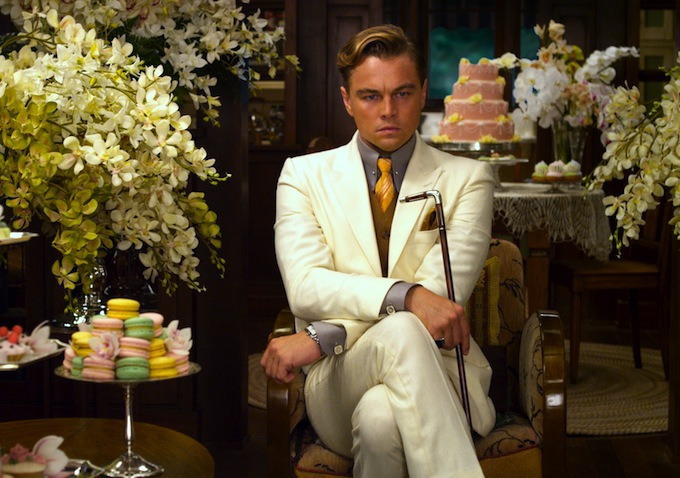
The camera never stops to register anything of note, not the expressions in the actors' faces or even the busy minutiae of the production design. My heart sank at the tackiness. Everything looks like painted cardboard, cheap and vulgar, except for the costumes, particularly the men's, by Catherine Martin.  Worse, everything looks like Disneyland. And everything is needlessly busy, since it is designed for 3D, a preposterous decision. I did not see the movie in 3D (go ahead, sue me), so certain gestures are too literal, like Gatsby (Leonardo DiCaprio) reaching his hand out on cue towards the water as he pines for Daisy Buchanan (Carey Mulligan). I winced and groaned at the lack of subtlety, and at some of the overblown choices, like introducing Gatsby to the strains of George Gershwin's majestic Rhapsody in Blue. There is nothing wrong with that music, but it refuses to be relegated to background noise (as Woody Allen brilliantly understood in the opening credits of Manhattan). Either you pay attention to it, or to the film. This haphazard chaos happens a couple of times with Lurhmann's sometimes clumsy assault on the senses, but then something mysterious happens. Once the story gets going, the movie settles down and gets out of the way. And what emerges is a hard, sparkling diamond of a story. A brutally sparse and elegant tale, exquisitely told by Fitzgerald's words, used to good effect, even as they are splattered across the screen, about the lunacy of American self-invention and optimism, and about the superficiality of money. It's as if the story is too powerful to let Lurhmann ruin it, and he shows some skill and restraint (of sorts) once things get dramatic.
DiCaprio brings a feral hunger to his portrayal of Jay Gatsby which completely jells with Nick's description of him as a striver. Everything is there: his trying too hard, his insecurity (a bit hammed up), the mystery that belies less of a mystique and more of a prosaic secret. He is very good (I bet he will get no respect) and he looks chiseled and dreamy in those magnificent suits. The rest of the cast is good too. Carey Mulligan tends to always be good in everything, but I thought she was too elegant for Daisy, who should be a slightly vapid airhead. Joel Edgerton and Jason Clarke play their American characters with vigor, and Isla Fisher is wasted in a small part as Myrtle. The formerly unknown Elizabeth Debicki has a star-making turn as Jordan Baker. But everybody in the background seems wrong, over the top, including Amitabh Bachchan as Meyer Wolfsheim, a Jewish prohibition gangster.
As for the preposterous idea that Nick Carraway wrote The Great Gatsby as he recovered from all that partying in a sanatorium, I found it more literal than offensive. I wish that McGuire would have shown more of Nick's crush on his cousin Daisy, and little more edge in general, since he is an outsider sharply observing the rich and the consequences of their behavior. For most of the movie he's just happy to string along with ever-widening innocent eyes. There should be more of a slow simmer to his gathering outrage. Still, this movie is much better than the pallid, boring 1974 version with Robert Redford and Mia Farrow, yet it made me wish that one day someone is going to come along and finally get it right.