Showing posts with label Harvey Weinstein. Show all posts

Sep 14, 2012

The Master


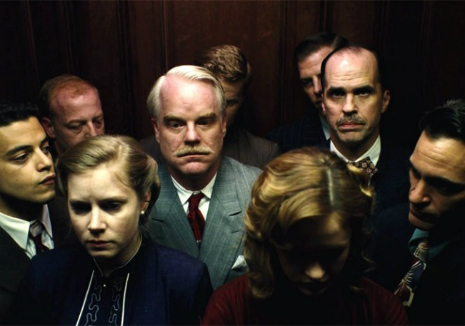
Paul Thomas Anderson seems to be on a heroic quest to make serious, epic American movies. After the stark solemnity of There Will Be Blood, comes The Master, written and directed by the filmmaker, a big, gorgeous looking film that seems related to There Will Be Blood in ambition and scale, but not much else. If TWBB (based on a novel by Upton Sinclair) was about a period of effervescent enterprise in American history, a characterization of the can-do American capitalist spirit taken to an alienating extreme ("I drink your milk shake!"), The Master seems to be about the polarities of mind versus body, rationality versus instinct, intellectuality versus feeling, mind control versus madness.
I was dumbfounded by the movie because I am unsure of the point it wants to make.
The two main characters, Lancaster Dodd (Philip Seymour Hoffman), the suave, articulate leader of a Scientology-like cult and Freddie Quell (Joaquin Phoenix), a troubled WWII combat veteran, are exact opposites in attraction and conflict. They may be fascinating as symbolic concepts on a page. As characters in a story, I'm afraid that they remain wholly intellectual constructs, despite the acting chops that both actors bring to their roles. The Master is a long movie with a stately pace, but it does not convincingly build a coherent case for the characters. I never quite understood their motivations.
Dodd, who is an imaginative, mercurial charlatan, is intent on mind control, and is fascinated by the challenge that Freddie brings. For Freddie is a world class drunk, the kind who drinks Lysol and mixes cocktails laced with paint thinner; a man broken by war, violence and loss. He is impossible to tame. The dialectic between them is pretty clear, but it remains a dialectic, there are no big turns in either man's character. Maybe it is too conventional to expect Freddie to realize that his master is a fake, and he kind of does, but then the movie does not follow up on this. The dysfunctional pattern of abuse in their relationship repeats itself over and over again. Inexplicably, Freddie allows himself to be run ragged by Dodd's cockamamie psychological treatments and he becomes a mindless enforcer. He doesn't seem to be a fervent convert to The Cause, as Dodd calls his movement, but he uses his rage against those who think differently, acting on violent impulse alone. One can clearly see how, with enough manipulation, certain leaders can get angry young men to commit acts of violence for a cause. In fact, Dodd mildly chastises Freddie for his outbursts, when it seems that he secretly enjoys his displays of brute force on his behalf. This I can believe. What is harder to grasp is why. Why is Dodd so taken by Freddie? Sheer challenge? Does he really love him? He has a skeptical son who delivers a crucial blow to Freddie's understanding of Dodd, but Dodd does not relate to his son at all. Is Freddie the son he really wants? Why is Freddie so taken with Dodd? Dodd's ideas don't seem to really make a dent on him. He just needs a home, a fold to belong to. In time, he does doubt, but not enough. In the end, Freddie is a maddening and opaque character, who refuses to act for himself, who has no convictions. Phoenix is extremely compelling, his face gaunt and askew, and he does a heroic job of trying to keep the audience on his side, using every hambone trick in the bag to portray a rudderless, traumatized man. But is is a labored, sweaty performance. It doesn't hold up to Hoffman's much more astute portrayal of Dodd. Hoffman is on his way to becoming a giant American actor. Here he is completely believable as a charismatic leader. He achieves this by underplaying. As Dodd, he seems totally relaxed in his own skin, absolutely convinced of his grandiose mumbo jumbo, while aware that he needs to be genial and flamboyant when required, to put on a show for the troops. It is a brilliant performance. Unfortunately, Anderson has tipped the scales on the side of exaggeration and conceived Freddie as such a jumble of raw emotion, that it's never an equal fight between the characters. It would have been more subtle and surprising if Freddie's madness was less over the top. There has to be a substantial level of sociopathy to undertake cult charlatanerie. Dodd always sounds exuberantly rational, even when he is spouting ridiculous new-agey bullshit. But Freddie is extremely damaged goods. I wish Freddie showed a cunning side, a surprisingly rational edge, to be able to fight this man more equally. The fight should be between a cult leader and someone who has the ammunition to fight him; otherwise it is lopsided and fruitless.
Amy Adams is used effectively as Dodd's controlling wife. Her aw-shucks, fresh faced goodness is in full bloom, but there is something cold and ambitious in her  (a bit too much a la Lady Macbeth). It's nice to see her play a meanie. Yet what motivates her other than, we assume, power? Anderson won't stoop to offer psychological detail. He is painting with grand symbolic, intellectual gestures. Dramatic opportunities are presented and then thrown away. For instance, Dodd's daughter tries to seduce Freddie, but he never uses this to defend himself from the milquetoasty accusations of her husband. Is it because he won't stoop to that? He doesn't want to hurt Dodd? On another instance, Dodd's wife reads her husband the riot act while she jerks him off in the bathroom. Perhaps this is supposed to mean that the master puppeteer is also dangling by some threads of his own, but then her threats are never brought to bear. A fantastic scene that takes place in jail, at the exact midpoint of the movie, where Freddie and Dodd  are in adjacent cells, Freddie going bonkers with rage, and Dodd just standing there, seems to encapsulate what the movie is about. A conflict/attraction between someone who thinks he can control people's minds, and someone whose mind is too crazy to control. Freddie confronts Dodd and accuses him of making the shit up. You would think that this is where everything turns in the movie, but no such thing happens. Freddie goes back to the fold without explanation. There are many such dramatic scenes that, compelling and intense as they are, find no fruition later in the film. The Master is too psychologically obtuse, and a bit of a bore.
The production design by Jack Fisk and the cinematography by Mihai Malaimare are flawless. It looks exactly like the 1950's: streamlined, straitlaced, repressed, about to explode without knowing it. I found the score by Jonny Greenwood (of Radiohead) a bit bombastic and pretentious, but the use of pop songs of the era adds much needed emotional guidance.  The Master seems to have been made as Art with a capital A, psychological clarity be damned (Anderson has always had a pretentious streak and it is in plentiful evidence here). Although The Master has powerful moments, it feels like it's all still duking it out in Anderson's head.

Feb 27, 2012

Oscars Postmortem 2012


As always, such an anticlimax. But, the consensus in my tiny Oscar watchfest was "they were not that terrible". Given that these are the Oscars, this is like getting an A-.
First, the dresses. Undisputed best look of the night, Rooney Mara. Best dressed, she was the only one who looked like a bona fide movie star. Second place goes to a brave and elegant Gwyneth Paltrow for pulling off a spectacular white dress. The rest was a parade of high-end schmattes, as far as I'm concerned. Put them all together in a rack and you'd think you were at a formal gown sale at Bolton's. It's a bad day for glamour when Penelope Cruz looks matronly. Where is Tilda Swinton when we need her?
I like Billy Crystal, but the shtick is not getting old, it's getting prehistoric. "Extremely Loud and Incredibly Close: that's how my relatives are watching this show". Me and the alte cackers who comprise the Academy are suckers for borscht belt humor. The rest of the world, probably not so much.
Am I crazy, or were there not enough stars? (Never enough stars). At least they had the decency not to bother with the Taylor Lautners and Ryan Reynoldses of the world. But I sorely missed me some Fassbender, some Mortensen, some Gosling, some Swinton, some Theron, some hormone blasting eye candy.  Alas.
I am still at a loss trying to understand what the hell was that commercial for Cirque Du Soleil in the middle of the proceedings. Although we are progressing as far as stopping audience abuse with musical numbers, apparently the producers cannot bear to part with random cheesiness altogether.  Who are we getting next year, Siegfried and Roy?
Obit time was long and corny, and is it me or they always use that song? There were some bad omissions: Raul Ruiz, Pedro Armendáriz Jr, Michael Gough, Michael Sarrazin, Arthur Laurents, Harry Morgan, Nicol Williamson. Instead, there was some marketing research guy in there.
Apropos of which, I thought the focus group bit by the fabulous Best in Show troupe was very funny. Focus groups are exactly like that. This was documentary in its realism. But if Hollywood thinks focus groups are so satanically moronic, as they are, why do they keep using them? Self-serving crap.
Was I moved by stars talking about how they love movies? No, because they didn't say anything specific. And who cares what Adam Sandler's influences are?  Anybody who opens a montage with a scene from Forrest Gump deserves a special circle of hell designed exclusively for them, with that scene looped at nauseam for infinity.
Emma Stone was charming. Ben Stiller should be disinvited posthaste (what was that skin color?), and as far as I'm concerned Will Ferrell and Zack G. can do no wrong. And last year's winners talking personally to the acting nominees is borderline offensive. It's like rabbis giving eulogies at funerals of dead people they never met. Horrifying. The rest is a blur.
Now, as far as the prizes: I was flummoxed by the techie love shown to Hugo, and thought it was mostly consolation prizes to Scorsese, until I read in Deadline Hollywood Daily that Hugo, which cost over $200 million to make, (and for some incomprehensible reason this obscenity is being rewarded) employed almost every tech guy in town and they all voted for it. Which explains. Because although it uses 3D and HD and ADHD, I found the look of the movie garish and applied with a heavy hand, sort of like a Parisian strumpet with a bad case of rouge. Which brings me to the one upset of the night that made me scream in horror. I was not rooting for cinematographer Emannuel Lubezki because he's a Mexican Jewish homie, but because his work in The Tree of Life is truly awesome and ravishing. Plus, he has been nominated 5 times and never won. I really thought he had it in the bag. It went to Robert Richardson's ugly, if super complex, work in Hugo. Aargh.
I had problems with many of the nominations to begin with. I would have gladly exchanged Kevin Spacey in Margin Call and Viggo Mortensen as Freud for Christopher Plummer and Nick Nolte. I would have loved to see Ryan Gosling for Ides of March or Michael Fassbender for Shame instead of Dujardin or Clooney. I would have loved to see Kristin Wiig or Charlize Theron instead of Glenn Close (who looked like the leprechaun in the Lucky Charms cereal box) or Viola Davis (yes, I've said it. I'm tired of her virtuoso weeping). 
And except for The Artist and The Tree of Life, I don't think any of the other 10 movies deserved a best of the year award. Do Moneyball and War Horse (which I haven't seen) deserve to be there, but not Bridesmaids? With bad choices to begin with, it's hard to get worked up about this.
The only awards I really cared about were that justice be made for A Separation, and for Meryl Streep, who everybody loves to hate because they cannot conceive she is as impossibly magnificent as she is. That was the one standing ovation that had actual merit in the entire show. She is the Grande Dame of American Acting if not of All Acting Ever, so back off, haters. She also does fake humility to a t.
As we have complained before, for the Oscars to have some sort of suspense, the ceremony needs to happen at the beginning of awards season and not at the end, when the outcome is almost uniformly a foregone conclusion. Let the voters not be swayed by the Golden Globes and the BAFTAs and the Golden Chickens. Let them do their homework. This would make them more exciting.
And BTW, next year, fix the sound problems. Geez.


Jan 28, 2012

The Iron Lady


There is a scene towards the beginning of this misconceived borefest that encapsulates the monster of acting that is Meryl Streep. There is no other reason to watch this muddled film. Streep is a freak. We all know she can do voices and mimic accents like an android, but in this scene, as Margaret Thatcher in old age, she is losing her memory and is confused, but proud, but bewildered, trying to remember; a dozen different feelings passing through her terrified eyes. Her face may be under layers of latex (the make-up deserves an Oscar), and she may mimic old age to perfection, but for a vibrant woman like her to express so truthfully what happens in the mind in the fog of old age, it is killer, killer stuff.  And we have not even seen her  at the height of her powers. Streep provides a technique fest: a different voice when she was younger, a lowered voice when she became leader of the Conservative Party, a perfect accent, the walk, the mannerisms. But she is a monster because within the meticulousness and fierceness of her preparation, she nails the moments of human truth. She nails every scene. No one should complain if she wins every award in the book. She deserves them all. Too bad she is so extraordinary in such a bad movie.
1. I am beyond exhausted with the overarching flashback convention in biopics, when we see the character in old age reminisce here and there about their most memorable moments, as if they were chocolate chips sinking in cookie batter. This plot device drains the story of tension and it muddles the arc of the character, which in this case is even more discombobulated because there seems to be no real backbone to the story. Why couldn't Thatcher's story be told chronologically, from a grocer's daughter to the longest serving Prime Minister of Britain, to doddering old age? At least we'd be excited by the conflicts she had to overcome, by the momentum of looking forward to what's going to happen, not to what already did.
So boring, I want to scream.
2. Harvey Weinstein. There a scene in this movie that is exactly like a scene in his last movie, The King's Speech. Do we really need to see a montage of Thatcher undergoing coaching, changing her hair into her famed blond helmet, as if she were an American Idol contestant? In this school of filmmaking even someone as formidable, fierce and polarizing as Margaret Thatcher gets the audience-pleasing Weinstein shtick. If you have Meryl Streep on board, it's enough to trust her humanizing capabilities and use her to paint a truly interesting portrait of a major political personality. No need to encase her in sugar. But no. There's this syrupy schmaltz about her fantasizing talking to her husband Dennis (Jim Broadbent), who's been dead forever. This unbecoming attempt to humanize her makes this movie into pap. 
3. Hamhandedness. How many scenes must there be of men snickering behind Maggie's back? Her story is not well served by a commonplace attempt to make it into a narrative of feminist triumph. Lots of women hated Thatcher with a passion. There is no need to turn her into a feminist hero. The woman herself, her achievements and mistakes are enough. Feminism becomes a tired cliché; it defeats the purpose.
4. As my friend the Media Mogul bitterly complained, have a point of view! Hate her and her policies, admire her, have an opinion about her turbulent tenure. Screenwriter Abi Morgan has written cloying pap which is completely inappropriate for Thatcher, an unsparingly unsentimental woman.