Jun 17, 2013

Much Ado About Nothing


This lovely adaptation by Joss Whedon of the comedy by William Shakespeare is breezy and charming and has a playful, sexy spirit. An unusual movie for the director of monster blockbusters like The Avengers, and creator of TV shows like Buffy: The Vampire Slayer, it's everything his bigger projects are not. In fact, it's everything most American movies are not. In elegant, if provocative, black and white, with mostly unknown (by me) television actors, unabashedly sexy (a true rarity) and featuring Shakespeare's unadulterated words. Mr. Whedon is some sort of freak.
He made this movie in his house in twelve days, while he was waiting to start post-production on The Avengers, (the third highest grossing movie of all time), feeling lost in the impotence of creating gazillion-dollar spectacles over which he paradoxically feels he has little control.
Without interference from studio blockheads and with his own money, he has made a delightful movie, with total command of tone and spirit. Choosing to transplant the Italian town of Messina to sunny, Mediterranean-looking Santa Monica, he liberates Shakespeare from the stuffiness of costume drama, moats and castles. As Shakespeare adaptations go, this the most laid back I've ever seen. The classy black and white cinematography by Jay Hunter makes it sexy and sophisticated, as leisurely as a luxury car commercial (this is a good thing). His uniformly good cast (with a special nod to the excellent Amy Acker) speak the lines as colloquially as possible, without sounding like Valley girls. In order to help those of us who don't always get Shakespeare's iambic drift, he resorts to good visual ideas and many welcome screwball moments. He has fun bringing Shakespeare up to date, where music comes from iPods, people get text messages announcing the arrival of some duke or another, and the meanies smoke pot. It really works.
The comedy itself is the usual Shakespearean romp. I won't give you the Cliff Notes, but two ornery antagonists, Beatrice and Benedict, set in their ways, impossible to woo and marry, are tricked to fall for each other. Meanwhile, Beatrice's cousin Hero is supposed to wed Claudio, but some bastard sibling of this noble family decides to ruin the wedding, as far as I understood, out of sheer malevolent spite. Whedon understands that there are real heartbreaking consequences in a bride's dishonor and when the play gets dark, he lets the pain really sting. Perhaps in our present time of Kardashian-style hos we don't easily understand that casting doubt on a bride's honor was truly tragic in Shakespeare's day. Hero would have tarnished the family name and she would have been untouchable, probably sent off to fester in a convent for the rest of her life. So the tears that flow are right. Same goes for Beatrice's deep frustration at being a woman living under male rules. There is nothing she can do to help her cousin in distress; her outrage at her own female powerlessness is authentic, and still resonant.
So for all of you who are bitterly complaining about how bad Man of Steel is, do like Joss Whedon, take a break from all the blockbuster madness, and give Shakespeare a try.

Jun 10, 2013

Before Midnight


The third installment in Richard Linklater's saga of Jesse (Ethan Hawke) and Celine (Julie Delpy) takes place in a beautiful part of Greece, on a Summer vacation, where we learn that these two have become partners, have two little twin girls and live in Paris. If you remember, they first met and fell in love on a train in Europe in Before Sunrise, when they were in their twenties, then about ten years of missed opportunities later, they met again in Paris, in Before Sunset. Now they have settled into middle age with undiminished rapport, but plagued with the myriad prickly issues of middle aged family life and the fear of getting older. To their credit, they still have a spark for one another and not all is lost... yet.
Jesse is a well known writer who has used his personal adventures with Celine as fodder for fiction in his books. It is not completely clear to me what Celine does for a living, but she is very vocal about her job dilemmas. The movie follows the couple as they talk a blue streak in this edenic spot. It is a funny, wistful and moving film, written by Linklater and the two actors.
Jesse has a teenage son from a failed, acrimonious marriage, and he feels pangs of guilt from living far away from him. Celine bristles at these confessions as intimations of Jesse to move the family to Chicago, which she refuses to do. The movie concentrates on this conflict and the sea of recriminations, true and petty, old and new, that it brings. In short, these two are married, even if they have never officially tied the knot. If you have ever been in such a relationship, chances are you will recognize a lot of the complaining as your own.
Linklater shoots long scenes mostly in real time with an easy rhythm and elegant, unobtrusive skill. A bravura one-take scene takes place inside a car, with echoes of Abbas Kiarostami, (the master of scenes in cars). The two actors don't miss a beat as they banter and argue while the twins sleep in the back. Hawke and Delpy's rapport has not changed, although at times they seem a little self-conscious and their dialogue a bit too arch.  However, much of it reports quite accurately what happens in real life. The frustrations, the weird dynamics; the prickly humor between people who know each other's tricks all too well.
What is lovely about this trilogy, besides being an admirable cinematic project, is that none of the films, as focused on romantic love as they are, have ever been unrealistic. Their charm and poignancy derive from the fact that they avoid fantasy. It's human love, warts and all. If anything, Celine has become a bit of a pest and Jesse too much of a saint as he deals with her hostility and her neuroses. It is annoying that she has become such a shrew while he seems as placid as Buddha (if passive-aggressive, as she points out).  I kept waiting for Jesse to put a stop to her shrillness, and at some point he eventually does, as she also brings some genuine anxieties to bear. The couple's bickering, which oscillates between charming and grating, escalates into a terrific all out fight, both lacerating and funny somehow, like many fights  between people who love each other.  There are nice, funny touches, like Celine storming out only to come back again and again, both to argue some more, and because it's clear that for all her protestations, she can't stay away.
Linklater knows when to linger on his actors' faces and even though there are long tracking scenes, he seems to get out of their way, so they can play. He doesn't call attention to the camera, just to his actors and their undulating beats. The only part that is too long and feels forced is a dinner scene that sets up Celine and Jesse among other couples at different stages of their relationships: a young, fresh couple such as they were when they first met, a couple slightly older than them, and two elderly people who have lost their companions. Somehow, waxing philosophical is not as interesting as eavesdropping on the couples' private conversations. In fact, any time the couple are alone together the movie feels sharper and looser than when they interact with others. The ending is quiet and bittersweet: the aftermath of fighting and reconciliation, the frail truce between two people that are trying not to drift apart. Somehow, we get a feeling that they are going to stick it out. It's all very romantic.


Jun 8, 2013

We Steal Secrets


I always had a feeling that Julian Assange was a creep, regardless of the one good idea he had with Wikileaks. And this was even before the rape allegations against him surfaced.
It's a spectacular and explosive idea to offer whistleblowers a safe place to anonymously expose the truth about governments and corporations, but there was something about Wikileaks that seemed not entirely thought through. Who decides what is shareable material? Is everything considered worth leaking? Is someone capable at the helm of the vetting process? And I am not talking about alleged classified information. Apparently, nowadays in this country everything is classified, including the Verizon phone calls you make to your aunt Mabel. I'm talking about a coherent criteria that is not just about some hacker's reckless obsession with sticking it to The Man. Obviously, there was much good and revolutionary about Wikileaks, but the power it could wield and the chaos and governmental paranoia it could unleash seem to have been a careless afterthought for Assange. Which he paid for dearly.
Gibney pieces his story together by fashioning a fascinating dramatic arc for Assange. He carefully lays out revelations that follow Assange's sudden rise from internet revolutionary and game changer, to paranoid loner who wants to spill the beans about everyone but himself. This movie is not sympathetic to him. Most of the people Gibney interviews are disgruntled former colleagues. He makes a case that Assange, far from being a political thinker or a revolutionary, was primarily a hacker, who operated with that sense of anonymous, self-righteous impunity. Much is paradoxical about a site that relies on anonymity commanded by a guy who loved the spotlight until it came back to bite him. It is a fascinating story about an unsavory character with one brilliant, dangerous idea. Gibney adds dramatic complexity by connecting it with the tragic fall of Bradley Manning.
The film is more sympathetic to Manning, a frail, sexually confused young man who had the very bad idea to join the Army, while the Army had the very bad idea of deploying him to war even after several recommendations against it from his superiors.  Gibney delves deeply into the intimate personal lives of Assange and Manning. He devotes considerable time, for instance, to Manning's transsexual yearnings, and his private messages to the guy who eventually ratted him out, Adrian Lamo, another creep. One wonders, is this relevant? Gibney also interviews one of the women who accused Assange of rape on a suspicious timing that seemed to coincide with Assange's persecution after Manning's leaks were published by his site. You are left to figure out for yourself what these accusations and their timing mean, although they don't make Assange, a man who apparently tends to tear condoms on purpose while he is having sex, look good. Ironically, it feels like Gibney is overly prying into intimate details, but the personal approach adds rich and fascinating layers to the motivations of these two hounded men.  Don't expect, however, a fair and balanced documentary. It has a strong point of view (Gibney is his own narrator) and leaves you to draw your own conclusions, a meandering, overly long but riveting primer on this chapter of our current history.

Jun 7, 2013

You Ain't Seen Nothin' Yet!


You sure ain't. I shoulda known better.
It is worth comparing this film by Alain Resnais and Bruno Podalydes with the Taviani Brothers' Ceasar Must Die. Both films are about staging plays for the medium of cinema, and in a sense, they are both about the transformative power of art, both made by directors at a late stage in life, but this is where the resemblance stops. For if Caesar Must Die is an emotionally rich, deeply human masterpiece that actually demonstrates the transformative power of art with real people (see here), Resnais' film is yet another misadventure into French intellectual pretentiousness, or as it is more accurately described, mental masturbation. It is nearly insufferable. And boy, is it cheesy.
This is the kind of French movie that gives French movies a bad name.
You Ain't Seen Nothing Yet is an adaptation of Eurydice by Jean Anouilh. It stars a number of formidable French acting talents, including the great Michel Piccoli, Denis Podalydes, Pierre Arditti, Matthieu Amalric. A bunch of famous actors are mysteriously summoned, in an annoying sequence in which each one answers the phone (being a big bunch, it takes forever), to the ridiculous house of a playwright (Podalydes) to read his will. This forces them (and us) to watch a new version of his play Eurydice by a young troupe of actors on a big screen TV. I was hoping that the famous actors would eviscerate the young and their cliched warehouse production, but no such fun thing ever happens. As the big names watch the rookies, they start reenacting the play itself and their performance intercuts with the one on the TV screen. I assume this is supposed to be some sort of arty Chinese box funhouse: ooh, I am watching a movie about a video about a play that is being performed by two sets of actors at once. Alas, the play is a garrulous, semi-poetic exploration of love and death and youthful rebellion: all bombastic ideas and no action. It sounds like it was written by a feverishly talented teenager, and it would be even more boring if the whole production weren't so kitschy, and I mean this in the worst sense of the word. There is a particular kind of French predilection for philosophical pomposity that falls into the preposterous. The play is about young lovers, but here they are played by much older actors. I know this must mean something important about the irrelevance of age and the eternal qualities of art, but as directed by Resnais with a very heavy hand, the play is much more unfunny than it could be and the actors ham out of control, particularly the two famous actresses playing Eurydice (there's three of them). Sabine Azema is positively ghoulish and Anne Consigny fares a bit better, dissolving in tears at all times. The movie is well edited and very well made, despite its unrelenting vulgarity. The backdrops are hideous, the cinematography garish, the actors are unhinged by hamming, except for Piccoli (always impeccable) and Amalric (being a messenger of death, he has the best lines and he delivers them well). Even the music sounds like it was made on a Casio.
Everything in this movie is artificial, but nothing is art.

Jun 5, 2013

The Great Gatsby


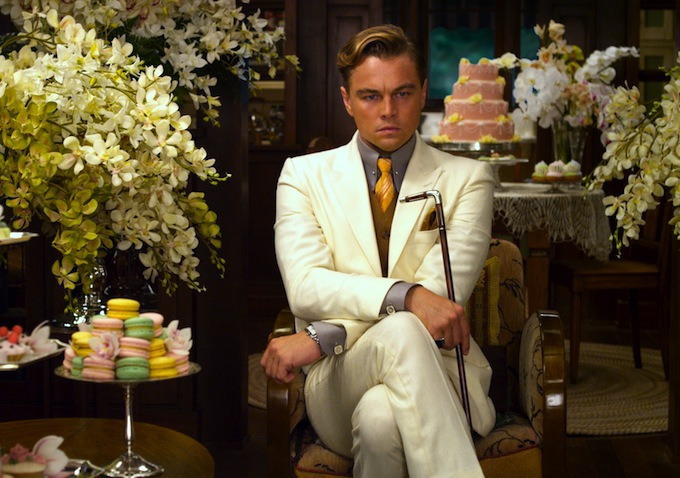
If only all Cliff Notes were like this! I realized halfway through Baz Luhrmann's version of the novel by F. Scott Fitzgerald, that if Luhrmann and producer Jay Z are able to interest young people who don't read books in this quintessential American classic, even if that means adding a hip-hop/roaring twenties mashup soundtrack (mostly quite good) and a generous dash of vulgar glitz, so be it. But that's because the second half of this movie is so much better than the first. The first half of this spectacle is hard going, since Luhrmann seems to have made "Great Gatsby: The Rollercoaster".
The camera never stops to register anything of note, not the expressions in the actors' faces or even the busy minutiae of the production design. My heart sank at the tackiness. Everything looks like painted cardboard, cheap and vulgar, except for the costumes, particularly the men's, by Catherine Martin.  Worse, everything looks like Disneyland. And everything is needlessly busy, since it is designed for 3D, a preposterous decision. I did not see the movie in 3D (go ahead, sue me), so certain gestures are too literal, like Gatsby (Leonardo DiCaprio) reaching his hand out on cue towards the water as he pines for Daisy Buchanan (Carey Mulligan). I winced and groaned at the lack of subtlety, and at some of the overblown choices, like introducing Gatsby to the strains of George Gershwin's majestic Rhapsody in Blue. There is nothing wrong with that music, but it refuses to be relegated to background noise (as Woody Allen brilliantly understood in the opening credits of Manhattan). Either you pay attention to it, or to the film. This haphazard chaos happens a couple of times with Lurhmann's sometimes clumsy assault on the senses, but then something mysterious happens. Once the story gets going, the movie settles down and gets out of the way. And what emerges is a hard, sparkling diamond of a story. A brutally sparse and elegant tale, exquisitely told by Fitzgerald's words, used to good effect, even as they are splattered across the screen, about the lunacy of American self-invention and optimism, and about the superficiality of money. It's as if the story is too powerful to let Lurhmann ruin it, and he shows some skill and restraint (of sorts) once things get dramatic.
DiCaprio brings a feral hunger to his portrayal of Jay Gatsby which completely jells with Nick's description of him as a striver. Everything is there: his trying too hard, his insecurity (a bit hammed up), the mystery that belies less of a mystique and more of a prosaic secret. He is very good (I bet he will get no respect) and he looks chiseled and dreamy in those magnificent suits. The rest of the cast is good too. Carey Mulligan tends to always be good in everything, but I thought she was too elegant for Daisy, who should be a slightly vapid airhead. Joel Edgerton and Jason Clarke play their American characters with vigor, and Isla Fisher is wasted in a small part as Myrtle. The formerly unknown Elizabeth Debicki has a star-making turn as Jordan Baker. But everybody in the background seems wrong, over the top, including Amitabh Bachchan as Meyer Wolfsheim, a Jewish prohibition gangster.
As for the preposterous idea that Nick Carraway wrote The Great Gatsby as he recovered from all that partying in a sanatorium, I found it more literal than offensive. I wish that McGuire would have shown more of Nick's crush on his cousin Daisy, and little more edge in general, since he is an outsider sharply observing the rich and the consequences of their behavior. For most of the movie he's just happy to string along with ever-widening innocent eyes. There should be more of a slow simmer to his gathering outrage. Still, this movie is much better than the pallid, boring 1974 version with Robert Redford and Mia Farrow, yet it made me wish that one day someone is going to come along and finally get it right.