Showing posts with label Film Review. Show all posts
Feb 9, 2015
Interstellar
Christopher Nolan's Interstellar is a good example of enterprising laziness. I'm sure he and his brother Jonathan, his cowriter, did a lot of research on black holes, wormholes, relativity and singularities. This must have taken all their time, since they did not bother to write a coherent screenplay. As with Inception, Nolan is happy to yank the audience's chain for hours without any concern for clarity.
The Earth is dying. Matthew McConaughey (giving it his all while trying to keep a straight face through the corny, incomprehensible dialogue) plays a farmer with a Texas twang that is exaggerated even for the likes of him. McConaughey is a frustrated astronaut. One day he bumps into NASA and a minute later they are sending him out to space because HE IS THE ONLY PERSON WHO CAN SAVE THE WORLD. He is a widower too, as is common in Hollywood movies. Why bother with a mother? He has a little girl who is a smart and stubborn pest, capable of holding a grudge for a lifetime. She is angry at daddy because he must go save the world. This is the level of writing. Busy and lazy at once.
Now, when characters (or actual people) take it upon themselves to announce that they are going to a) change the world or b) save the world, I feel like punching them in the face. It seems to me that those who do things to save the world do not go around solemnly declaring their intentions.
But there goes McConaughey, seriously torn between saving the world or staying with his family. What a tough, if contrived, choice. So he gets on this big secret rocket, but lo and behold, he is not alone. Anne Hathaway is with him, working her damnedest to erase any trace of charm or a sense of humor because she plays a serious scientist. And because sex is forbidden in Hollywood, even if Earth runs the risk of depopulation and they are traveling with canisters of frozen human eggs to create a new humanity elsewhere, it never occurs to these two handsome people to start shagging like bunnies, which is what anyone with any sense would do under the circumstances. If not for increasing the population, at least for recreational reasons. Space is a lonely place.
Hathaway happens to be the daughter of Michael Caine, who works for NASA despite his remarkable Michael Caine accent (pretty decent, but not as good as Steve Coogan's and Rob Bryden's). He is trying to solve a mysterious equation that -- guess what -- will save the world. It is never explained why he has no qualms about sending his daughter to outer space.
Then Matt Damon shows up in some frozen planet. We are always happy to see him. Alas, he's gone too soon. People age 127 years in a matter of minutes, which is what happened to me after sitting there for three hours, glazed over by boredom and by a certain bemusement at how anybody can attempt to meld such disparate things as the time-space continuum and a moody child. Gravity suffers from similarly cheesy writing, but at least Gravity is gorgeous and thrilling. And the story makes sense.
Meanwhile, Nolan is incapable of putting a sequence together. Everything is a series of gigantic anticlimaxes. He cuts out of the interesting stuff before he gives the audience a chance to gasp, but stays on the boring stuff. He cuts back and forth from space to the Earth, killing the momentum in every scene. I said that the scenes reminded me of orgasms that fizzle out and was told I was giving the movie too much credit. There is nothing resembling an orgasm in this film. There is no joy, there is no beauty, there is no awe, only plenty of fake heroics and forced feeling. Watching Interstellar made me pine for Steven Spielberg.
The busy music by Hans Zimmer (using an organ to remind us that instead of letting our lives ooze away we could be watching 2001: A Space Odyssey) gives the impression that something is about to happen, but the most exciting thing that happens is the cosmic equivalent of trying to fit a lid on a plastic container; that is, McConaughey trying to park his module correctly. The paucity of imagination is astonishing, considering the lengths Nolan goes through to incorporate the theory of relativity into a telenovela.
Visually, except for a pretty shot of Saturn, all we see is spacecraft sideboob. Nolan seems to think that the most interesting angle in space is from the side of a rusty spaceship. He is not interested in space. He is interested in letting us know, as if nobody has never entertained this notion before, let alone expressed it in a million other movies, books, songs and Hallmark cards, that love is the only thing that can save us.
That Nolan attempts to salute Kubrick is evident. He falls comically short.
There is no movie about space that does not hark back to 2001. But 2001 is poetic, enigmatic and existential. It makes you consider our size in the scheme of things, where do we come from, are we alone in the universe? It would not occur to Stanley Kubrick or Arthur C. Clarke to saddle Dave the astronaut with a sob story about his family back at home. In 2001 when Dave speaks to his little daughter from space, it is her joyful nonchalance that makes us realize how lonely space must be. Not everything has to be a vale of tears.
Instead of robot Hal 2000, an elegant, disquieting presence with a soothing voice and a scarily omnipresent lens, we get TARS, an ugly piece of junk with a mid-western accent and a feeble sense of humor. Instead of that crazy white room in 2001 in which Dave sees himself at the end of his life, we get a visualization of the time dimension, which could be pretty cool but for the fact that it is predicated on people saving the world. And you know how I feel about them.
Nolan is good at one thing: convincing Hollywood to give him millions of dollars to make ridiculous movies that, because of their deliberate, inane opacity and their geeky pretentiousness, seem smarter than they are.
Jan 24, 2015
Mommy
Xavier Dolan's winner of the Grand Jury Prize at Cannes (he shared it with Godard's Goodbye To Language in 3D) is nothing like it sounds. A recently widowed mother, Dianne, also known as Die (the fierce Anne Dorval), has to pick up her teenage son Steve (Antoine-Olivier Pilon, amazing) from a detention center and and take him home because no one else will have him. She is a mess: rude, potty mouthed, unemployed, and as unfiltered and undisciplined as Steve.
Dolan frames the story in the near future, in which Canadian law could allow parents to relinquish their pathologically unruly children to the state with no further legal review. And believe me, during the first 10 minutes you will be rooting for her to do just that. Steve is impossible. Fitfully charming, grating, violent, chaotic, no school or social setting will abide him. But he is not one of those dark kids with homicidal tendencies, like the Newtown or Columbine murderers (perhaps because he doesn't go to school). He is just more than a handful, in the care of a mother who is a handful herself. They've both been on a tailspin since they lost Steve's father to illness. They feed on each other's passionate chaos.
In less inspired, confident hands, this film would be a bitter or too saccharine pill to swallow, but Dolan, who is only in his mid-twenties, is a gifted filmmaker. He elicits spectacular performances from his actors. Even with a 1:1 aspect ratio, which is a perfectly square frame, Mommy is so beautifully shot that two seconds into the movie you forget the format. And in fact, this intimate shape helps convey the isolation, the narrow focus that is required to live with someone who cannot really function in society. The camera and editing are fluid, kinetic and masterful. A sequence in which Steve unleashes his chaos as he arrives home is handled so well, you feel like you are in the room, engulfed by two human tornadoes, and you don't know what just hit you until it's over. But Dolan also achieves moments of tender grace. This fierce story of maternal and filial devotion will test your patience, give you hope and break your heart in equal measure.
Dolan does not shy away from big dramatic gestures as he burrows into the heart of sorrow, chaos and relentless energy which is to be Steve and Die. He introduces a third wheel, Kyla (the excellent Suzanne Clement), a lonely neighbor with a mysterious grief of her own, who completes their family at the expense of her own. Mommy surprises at every turn with its self-assured intensity. One can see the poetic gesture in awarding the Cannes Jury Prize to the old Godard and the young Dolan, for Dolan has the verve and the inventive cinematic flair of the young Godard, but, less in thrall to sheer intellect, he dives deep into waves of emotion.
Jan 3, 2015
Leviathan
A dark political fable from Andrey Zvyagintzev, this bitterly funny, tragic movie could be interpreted as a modern day retelling of Job's story about a man besieged by fate, lost in the belly of a whale, except in this case, he is besieged by the corruption and impunity of a local functionary who has seized his property, refuses to pay a fair price for it, and intends to build some grand monument in its place in a backwater in the middle of nowhere, Russia.
Winner of best screenplay at Cannes, Leviathan is not only a chronicle of the destructive powers of unimpeded graft, but also a look into a culture which harbors a dangerous combination of powerlessness and recklessness. This may be the movie where individuals drink the most in the history of cinema. Their shots of vodka are downed in 4-ounce glasses filled to the hilt. They chug vodka by the bottle. But then again, there is nothing else to do in this nameless northern town, home to fish packing factories, boat and whale carcasses, and abusive local authorities.
Zvyagintzev takes his time introducing us to his characters: Kolya, a car mechanic and volatile heavy drinker, who is not a bad man, his younger, unhappy second wife Lilya, and Kolya's ornery teenage son, Roma. Dima, a friend from Kolya's army days, comes all the way from Moscow to help Kolya defend himself against Vadim, the corrupt official who has all institutions in town, including the arrogant patriarch of the local church, in his pocket.
Because these people are human, they do all kinds of fucking up on their own besides trying to fight Vadim, which helps him destroy them and makes it a far more interesting movie than if they were just in a righteous crusade for justice (that would be the American version). Kolya built his house on a hill overlooking the bay with his own hands, it has been his family's land for generations, but Vadim cares not for roots, history or people. He uses a combination of drunken threats, the misapplication of the law, and their own recklessness to get them out of the way.
Before it turns tragic and appallingly ironic (in the real world impunity always wins), much fun is to be had observing local custom. Policemen who drive and shoot target practice while drunk out of their gourds (with children running around, to boot), teenagers with nothing to do but drink inside the ruins of an old church, women that counsel others not too drink so much while pouring them another hefty glass, and the ridiculous theater of bureaucracy in the guise of endless laws, articles, codes and paragraphs completely perverted to serve power, a sham designed to trick people into thinking they live in a lawful country.
If this is not a parable about life under Putin, I don't know what is. Mystifyingly, the movie got made with governmental support, which means that either the censors are idiots, or Putin wants to show the world that there is some sort of freedom of expression in Russia.
Leviathan is a fantastic movie. Anybody who has ever lived under brazenly corrupt regimes will understand in their bones the combination of frustration, exhaustion, outrage and ultimate capitulation that these Russian folks experience. You laugh until it sobers you up.
Dec 23, 2014
Best and Worst of 2014
I was a bit underwhelmed by movies this year. Somehow, I felt last year had more punch.
Here's my list.
Excellent
Timbuktu
Boyhood
Whiplash
Ida
Force Majeure
The Wonders
Leviathan
Two Days, One Night
Mr. Turner
The Grand Budapest Hotel
Foxcatcher
Selma
Mommy
The Babadook
Under The Skin
Obvious Child
Jodorowsky's Dune
The Unknown Known
Citizenfour
Bad Hair
The Passionate Thief - A restoration of Mario Monicelli's classic
Very Good
Birdman
A Most Wanted Man
Locke
A Most Violent Year
Calvary
Yves Saint Laurent
Magic in the Moonlight
Venus In Fur
Good
Gone Girl
Big Eyes
The One I Love
The Two Faces Of January
Blue Ruin
Snowpiercer
Listen Up, Phillip
Young And Beautiful
Frank
Top Five
The Trip To Italy
Eden
Pasolini
The Princess Of France
Clouds Of Sils Maria
Love Is Strange
Could Be Better
The Immigrant
The Imitation Game
The Theory of Everything
Inherent Vice
The Blue Room
Rosewater
Enemy
Into The Woods
Art and Craft
The Skeleton Twins
Beyond the Lights
Overrated
Dear White People
Guardians of the Galaxy
Saint Laurent
Nightcrawler
Only Lovers Left Alive
Morally Dubious
American Sniper
Pretentious
Jauja
Goodbye To Language
So Bad It's Good
Exodus: Gods and Kings
Bad
Interstellar
Wild
Time Out of Mind
A Master Builder
I Origins
So Bad It's Terrible
Noah
Despicable
Heaven Knows What
Could Be Better
The Immigrant
The Imitation Game
The Theory of Everything
Inherent Vice
The Blue Room
Rosewater
Enemy
Into The Woods
Art and Craft
The Skeleton Twins
Beyond the Lights
Overrated
Dear White People
Guardians of the Galaxy
Saint Laurent
Nightcrawler
Only Lovers Left Alive
Morally Dubious
American Sniper
Pretentious
Jauja
Goodbye To Language
So Bad It's Good
Exodus: Gods and Kings
Bad
Interstellar
Wild
Time Out of Mind
A Master Builder
I Origins
So Bad It's Terrible
Noah
Despicable
Heaven Knows What
May 19, 2014
The Immigrant
This is one puzzling movie. In general, I enjoy the films of James Gray, a director who likes to tell intimate family dramas about mostly immigrant New Yorkers (Little Odessa, The Yards, We Own The Night, Two Lovers).
His films are of small scope but big emotional gestures, modest but solid. This time, he transports us to early 1920's Ellis Island, where two Polish sisters have just arrived with thousands of aspiring immigrants. One of the sisters is sick and coughing, and gets separated from Ewa (Marion Cotillard). Ewa is denied entry on the grounds of loose morals (which is rather rich coming from the deeply corrupt authorities) and plucked out of the deportation line by a Bruno Weiss (Joaquin Phoenix), who promises to give her a job as a seamstress. It turns out he is a burlesque emcee and a pimp who trolls Ellis Island to find girls for his revue. And she has no choice but to stick with him.
The story is old fashioned and has the trappings of grand melodrama. In La Cotillard's performance, it has a heroine who is traumatized, innocent, but a shrewd survivor.
The amber toned cinematography by Darius Khondji seems to suspend everything in a dusty past. The movie is slow and heavy like molasses.Casting Joaquin Phoenix as a Jewish two-bit impresario does not help. There is nothing about him that feels vaguely from New York, (he seems to have just arrived from Hollywood and Vine) but he is, as usual, riveting. He is a good ham, he makes quirky choices, he has some good moments. I could watch him snore and be mesmerized, but he seems rather uneven and adrift in the part. I think of Paul Giamatti or Stanley Tucci, or even Adrian Brody: someone who screams old New York. Jeremy Renner, who plays Bruno's cousin, a Houdini wannabe and rival for Eva's affection, tries to dazzle, but also seems wrong. In general, the main characters are thinly sketched. The only one who is busy filling in the blanks with more layers than anyone has any reason to expect is Marion Cotillard.
She seems as fragile, scared, traumatized and stubborn as she is supposed to be. She is a great silent actress, but she is also capable of acting persuasively both in Polish and English, none of which are her native language. She also happens to be stunning, and Khondji lights her beautifully. Whether she's tired and gaunt and without makeup, or made up like a floozy, you cannot take your eyes off her. She is so good, I can't think of anybody else in the part.
The story sounds good on paper: A crook falls for a defenseless woman he intends to use for profit and she ends up changing him. They are both reluctant to fall under each other's spell. I suspect that a lot of what feels inactive has to do with a script that tells us about bad stuff that happened, yet we don't get to see it. We are told things we already know, we are told by the other girls that Weiss is in love with her. We only see this clearly towards the end, in a scene where he listens in to her confessing to a priest, and he has a realization that he is destroying her. Then he confesses to her something that we knew from the beginning. There is no momentum. The actions are broad and melodramatic, but they seem imposed on the characters, not earned by force of personality. It was unclear to me if Ewa was that innocent, or if she used her innocence to preserve herself. I was not sure if she was equally repelled and attracted by Weiss, but sparks should have flown while they only sputter. I still enjoyed the really old fashioned story, the mournful music, the way Gray summons the convoluted and hypocritical morals of the day, but I kept wondering why such a big, redemptive drama feels so confined and airless.
Oct 18, 2013
All Is Lost
There are two movies this season that are very similar in their preoccupation with man against the immensity of nature, where human accomplishment is suddenly brought to its knees and made to eat major humble pie.
All Is Lost, written and directed by J.C. Chandor, is like Gravity at sea. But in contrast to the more jokey, commercial endeavors of Gravity, it is a much more sober film, and an impressive writing and directorial improvement for Chandor, after his first film, Margin Call.
Robert Redford has never been the most expressive of actors, but he is perfectly cast and very effective as Our Man, a lone, rugged sailor who is somewhere in the Indian Ocean on a nicely appointed sailboat, when he runs into trouble. We know little about him, and he says even less during the course of the movie. His character is revealed by all the decisions, big and small, he makes to survive.
The individual choices Our Man makes are small, methodical, but essential steps he takes to salvage his boat and keep himself alive. This is not a visceral movie. It is beautifully shot, and at times everything seems a little too perfect (curiously, the lens never gets wet, even when the storm is raging), but it does give you the sense of what it is like to be alone and surrounded by merciless water, whether under the cruel sun or tossed about in a vicious storm. One learns a lot about the kinds of things you could do in case you're stranded in the ocean like Our Man. With any luck, you will have an extremely well-equipped boat, like he does. And even then, all that man made ingenuity and wealth of resources may fail you.
All Is Lost reminded me of the power of visual storytelling, which is how movies began. The movie is transfixing without dialogue. Our Man is extraordinarily self-possessed, considering his dire circumstances. Clearly, he is a man of few words, even when alone against nature. Chandor has written an elegant, economical script and has wisely resisted the temptation of giving too much information to the audience or plucking too much on the heart strings. This is not a sentimental movie. Chandor gives the audience the opportunity of filling in the blanks of the character, something that is usually absent in commercial films, which refuse to leave anything to the imagination.
At the beginning there are clues as to who he is to others. And because he is so precise in his behavior, and so true to character, one can come up with an interesting back story. I imagine he is wealthy, a titan of industry, used to everything going his way, a leader, who when faced with imminent extinction, does not panic and methodically tries to fix things. This is in stark contrast to Clooney's and Bullock's gabfest in Gravity, and it is so much more mysterious and interesting. I could have used a little more panicking from Redford, who has one fabulous moment where he finally loses it, and with good reason. But because he so clearly establishes who he is by how he does things, his sangfroid is coherent with the character, if not entirely believable at all times.
All Is Loss plunges us into chaos immediately. We experience the ups and mostly relentless downs of this man's losing battle against the ocean. There are some inspired images, like a flock of floating sneakers bobbing out of a stray container, or Our Man wading almost dreamily inside the flooded boat to retrieve a spoon and a fork. He is a fastidious, refined man, and not about to become a savage just because he is lost at sea.
The sound design is fantastic. The cinematography, both over and underwater, is gorgeous. Alas, there are a couple of moments that undermine the very thoughtful craftsmanship and conceptual approach of this film. The music at the beginning is very good; just a couple of menacing chords that blend seamlessly into the terrifying sounds of invading water. I was thanking Chandor in my head for being extremely adroit with the use of music, when out comes a sequence where the music blooms into a horrid, cheesy melody that has Our Man covering his ears in despair. It isn't clear if he is hearing it in his head, in which case he is right to loathe it, but it happens at a key turning point and it shatters our illusion of being there.
Similarly, some people may feel the ending is a cop out, but, even if it is a bit contrived, it is handled with grace and understatement, and it is justly rewarding.
Oct 11, 2013
NYFF: 12 Years A Slave
This film by Steve McQueen (Hunger, Shame) is based on the harrowing real story and book by Solomon Northup (Chiwetel Ejiofor), a free Black man from Saratoga, NY, who is kidnapped to be sold to slave owners in the South. It is McQueen's most conventional film to date, and though it is a powerful movie that retains his trademark unflinching look at intense human suffering, this time focused on slavery, there is something stilted about it. All his movies have a paradoxical tension between extreme emotional states and aesthetic distance, which works well with their intimate scope. But this is a big period epic, and you can feel the tension between the need to tell a story in a more conventional manner and McQueen's suggestive style. There is tension, for instance, between the eloquent literary, almost theatrical dialogue, which sounds faithful to Northup's narrative, and the realistic depiction of brutality.
The most astounding scene in the movie is a wordless tableau that takes place in the middle of the film and that says more about the depravity of American slavery than anything else in the movie, or anywhere, for that matter. Were it shown separately, it would be one of the greatest short films ever made. This is the kind of condensed visual metaphor that makes McQueen an exciting director, but this style is mostly sacrificed for more straightforward storytelling, and by corollary, more commercial possibilities.
The filmmakers want to make the story accessible to the widest possible audience, which is as should be. But this responsibility to garner a wide audience presents an interesting conundrum. I could not help but think of the Holocaust, because the parallels with American slavery are many and obvious, as are the parallels on how genocidal violence is depicted in film.
Slavery is the African-American Holocaust. McQueen makes sure this is branded into our consciousness by showing episode after episode of unspeakable cruelty. Sticking closely to what Solomon Northup witnessed and lived through, the experience of this film is as close as we're ever going to be to what it was like to be a slave.
Still, cinematically, the magnitude of slavery as a crime against humanity is so unfathomable, that any attempt to dramatize it creates an obvious problem with authenticity, which is generally true of Holocaust movies as well. How, for instance, do you use music to punctuate such circumstances? Any fictional embellishment threatens to banalize the authentic depiction of historical evil. The use of well known actors becomes distracting, even if all the famous talent in this film (Paul Giamatti, Benedict Cumberbatch, Michael Fassbender, Brad Pitt, Paul Dano, Alfre Woodard) rises to the occasion. In United 93, also a movie about a historical act of human evil, director Paul Greengrass bypassed this problem by using unknown actors, giving it unquestionable verisimilitude. It worked, but nobody saw it.
This is the paradox of this film.
Perhaps this is why McQueen chose Ejiofor, a well-known British actor, but not very known here, and newcomer Lupita Nyong'o for the main slave roles. They are both very good. Solomon Northup, urbane, educated, sensitive, and appalled at his fate, learns to obey and quell his temper and dignity in order to preserve his life. He cannot fight back, so his journey is the opposite of what we are used to from cinematic heroes: from being a well rounded, accomplished human being, he needs to do less and less in order to get out alive. His heroism relies in surviving and trying to hold on to his last shred of dignity, even when forced to collude in his own dehumanization. Chiwetel gives a very empathetic performance, but there is something about a passive hero that makes it hard to connect for the audience.
Like any other form of institutionalized sadism, slavery is shown to cast not only a dehumanizing pall on slaveowners and slaves alike, but it is encased in its own bizarre bubble; an insane parallel reality. In the dissolute character of slaveowner Epps (Michael Fassbender), corrupt madness runs like a fever. Epps is an ignorant, Bible thumping drunk; cruel, childish, arbitrary. Fassbender is very good at showing his spineless weakness. There is nothing grand about him. He is at the bottom of the human totem pole, a grotesque character, a second rate bully, clearly inferior to Northup in every way.
From the beginning, McQueen establishes that slavery was unregulated capitalism at its nadir. Although he makes clear that even those who profited from it were aware of its revolting effects, even judicious people, such as Thomas Jefferson, engaged in it. It is particularly chilling to think that Northup's descent into hell, as McQueen shows with close ups of water churning through the wheels of a river boat, was only a short journey from New York to Washington D. C.. He went to dinner one day with whom he thought were potential business partners, and woke up in a dungeon in chains. There was a legal and economic system in place that allowed this to happen, and there was nothing he could do about it.
This powerlessness sparks enormous moral outrage. The film's effect is cumulative: it lashes out at you relentlessly - as life lashed out at Northup - until its cathartic ending. This is not a wishful tale about righteous white people with good intentions. It is not fiction. It is a remarkably evenhanded and perceptive eyewitness account of slavery from a survivor. The hero is a Black man, and he engineers his own survival. In this sense, 12 Years A Slave is possibly the truest film about the topic ever made.
Yet McQueen's approach, even as he meticulously documents the most harrowing scenes of cruelty, feels somehow emotionally detached. The piling up of horrors, if utterly valid and faithful to Northup's experience, makes you brace against it. Only at the end I felt a cathartic emotional release. Perhaps this is intended to mirror Solomon Northup's own journey: in order to survive, you have to harden your heart. Unlike Steven Spielberg's Amistad, 12 Years A Slave is unadorned with human pieties. It's an endurance test that shows no mercy towards the audience.
Hopefully, 12 Years A Slave will spark a serious conversation about slavery in this country. For all of our boisterous public debate about race, very little is discussed about slavery (unless, I assume, you are stuck in history class in high school). This is perplexing, to say the least. Considering how important it is a chapter of American history, more needs to be discussed. Because even today there are economic systems in place that are not too distant from slavery: the abuse of undocumented migrant workers, private prisons that profit from the wholesale incarceration of mostly Black and Latino people. The nasty unethical, yet fully legal, exploitation of certain groups continues.
This movie put a thought in my head:
The still benighted South, home of a majority of people who think universal health insurance is communism, and who'd rather die than pay taxes for a more progressive and cohesive society, should be made to pay reparations to the descendants of slaves in America. This is not a new concept, but perhaps 12 Years A Slave will bring the idea back to the table. This movie intends to reopen an old wound. I certainly hope it does.
12 Years A Slave opens October 18.
Oct 9, 2013
NYFF: The Bad And The Ugly
We're almost 3/4 of the way through our movie marathon, and this year's edition of the Festival has been a little lackluster, in our humble opinion.
We've seen a bunch of duds, starting with the silly, humorless Real, by Kiyoshi Kurosawa, a movie for 14 year-olds without a shred of lightness or wit. It's a science fiction romance about a young woman in a coma, and her boyfriend, who is allowed to roam her mind. The premise is fantastic and full of interesting possibilities. The movie is great to look at, with a crisp, stylish use of CGI, and it has some good creepy moments. Being inside someone else's mind is not necessarily a walk in the park. I fail to understand how it made to the festival. It's not a good sign when the audience claps thinking the movie is thankfully over and laughs when it insists on going on. This is one instance where a smarter remake is in order.
I hated Bastards, Claire Denis' exploitative, sordid, gratuitous, sloppy movie. I surmise she set out to make the film noir to end all noirs, some sort of depraved version of Chinatown, and, as far as I'm concerned, it did not pan out. Her brilliant contribution is to think she can intersperse bits of plot out of sequence, but this is not only disorienting, it's confusing and makes no sense.
Bastards is a visually and spiritually ugly movie, with a puerile, simplistic wish to disgust disguised as an attack on capitalism (major yawn), a flimsy plot and otherwise dignified actors like Vincent Lindon (only good thing in the movie) and Chiara Mastroianni trying to impart coherence to barely sketched out characters.
It's a good story. A ship captain, estranged from his wealthy family, comes to shore to help his relatives at a difficult juncture and unravels a web of human depravity: a classic tale of diving into the darkest pits of the underworld. But nothing is believable. Instead, Bastards is some sort of pretentious intellectual exploration of genre. Plus, every time I see Lola Creton and her insufferable pout onscreen, I want to strangle her.
There are very few times when I want to unsee a movie, when a movie so pollutes my consciousness, that I want to scrub my brain with lye. This is one of those times. And it's not that what disgusts me is the trite revelation of depravity that Denis taunts the audience with for two hours and saves like a dog salivating over a bone towards the end; it's the utter lack of empathy, grace or genuine human feeling. That, and the terribly cheesy music, vulgar and in bad taste, like the rest of the movie. It made me gag.
The fact that Bastards was made by a woman doesn't make it any less prurient and exploitative. This movie is the equivalent of watching an exhibitionist fondle his dick in public. There is no meaning, only self-absorption and the perverse wish to molest.
Oct 6, 2013
Gravity
The images are of astonishing beauty. The first 15 minutes of this film fill you with wonder. You are witnessing, almost experiencing what it must be like to be in space; in joy and terror. Sometimes you remember to ask yourself what the hell you are seeing: you do an internal double take, a swift reality check to remind yourself that Sandra Bullock and George Clooney are not floating around in space. It is a feat of human ingenuity to put those two huge Hollywood stars in such a backdrop and still create the successful illusion that they are actually there.
Gravity is a spectacularly beautiful, thrilling and wondrous feat of artistry and craftsmanship. It works wonders in 3D and I assume that it's even better in IMAX.
I say this every year, so here it is once more, with feeling: If cinematographer Emmanuel Lubezki doesn't win an Oscar (his umpteenth nomination) this time, there is no justice in the world; hell, in the entire universe. He is the undisputed master of point of view, as he has amply shown in movies like Tree Of Life. And more: the way the camera captures everything both in outer space and inside the modules, everything we see is stunningly, delicately, magnificently gorgeous. His camera and his light are sensual and sensitive, even in space. The camera moves like nothing you've ever seen before. It is astonishing, as are the special effects and the art direction, all of which should swipe every accolade and award.
Sandra Bullock gives a fantastic performance as Dr. Ryan Stone, in a very basic story of survival in space. She is very good, and George Clooney is his usual charming self. Both command the screen even when encased in astronaut gear. Somehow, they are not dwarfed by the surrounding cosmos.
So why does the heart sink, why does everything come crashing down to earth like a merciless meteorite? It pains me to say this, but the writing is terrible. Everything is weighed down by triteness. That Bullock and Clooney are the chosen vessels to conduct the corny dialogue is fortunate; they pull it off with great panache. Actors of less stature would make the flimsy writing even more glaring. Bullock gives her all to impart weight and feeling to her predictable, utterly needless lines. And Clooney brings his reliable Clooneyness to his character Matt Kowalski; you truly feel that you are in good hands with him, as an actor and an astronaut.
Yet I was praying that at some point the words would stop. I wish Cuarón had heeded the example of Theodore Dreyer in The Passion of Joan of Arc (or, closer to home, Stanley Kubrick and 2001) and stopped the script from blabbing. Everything we need to know and feel is in Bullock's face and in her breathing. She doesn't need to talk.
I also thought of The Hurt Locker as a great example of how an action movie can have existential heft by stripping the dialogue to its barest bones. In that movie, the soldiers, when confronted with lethal danger, use words only when absolutely necessary, for the most basic instructions; yet somehow this imparts the movie with gravitas and existential meaning.
I get it: if you are alone in space, you talk to yourself. I know I would. You are not suddenly going to become Schopenhauer. But in Gravity, the dialogue is jokey, and hokey and disappointingly trite. There is no irony. There is no edge to the humor. Ryan's painful past seems manufactured by the Hollywood trope factory.
Nobody expects philosophical pontification in a movie that is clearly designed to be a thrill ride, but one knows that Cuarón has done and can do much better. It's as if he and his son Jonás, who co-wrote the film, were abducted by the Hollywood shitty one-liner squad, and this sinks the movie. I don't mind Kowalski's garrulousness. Even though Clooney does not really give it that nuance, it is obvious that he fills the void of space by talking a blue streak. But when he asks Ryan what she loves most about space, and she answers "the silence", a good zinger and a heartfelt thought, why is there soaring music in the background? Why is there a fear to let the audience experience that silence? Some gravity is in order. I loved the ominous, abstract music by Steven Price at the beginning. Did it have to bring in the weepy, epic string section towards the end?
The writing ends up relegating space to a backdrop, instead of using it to investigate how we measure up against the universe. How far we've come, how remarkable and insignificant we are. That's what space is for. Instead, we get stuff more suitable for a Lifetime TV Special.
It is hard to reconcile the facile, sketchy writing with the painstaking artistry of the rest of the film. I wanted to leave cheering. I left pondering why a movie that is such a magnificent achievement in so many levels is so careless and unsophisticated with something so essential. Gravity could have been a masterpiece. It is just a fantastic entertainment.
Oct 2, 2013
NYFF 2013: Club Sandwich
Fernando Eimbcke's third feature is a wry, sharp, sweetly funny coming of age story with a twist. Héctor (Lucio Giménez Cacho Goded) is a chubby, awkward teenager on vacation with his young mom, Paloma (the spectacular María Reneé Prudencio). They are staying in a deserted hotel in Puerto Escondido, Oaxaca, which seems suspended in time. In fact, time seems suspended in time, since nothing much happens. At the beginning, we are not even sure if they are mother and son or brother and sister, such is their rapport. They apply sunscreen, they lie like lizards by the empty pool, they play rock paper scissors to see who takes a shower first. Paloma has an eyebrow piercing, tattoos and an attitude. Héctor is mutating into adulthood, which means he is a sulking, monosyllabic teenager with secret desires. Their chummy relationship is clearly on the cusp of changing. They bicker over their choice of underwear, and there are times when Paloma can feel his awkwardness shutting her out, as he starts objecting to the status quo.
One day, a family arrives. A chubby teenage girl, an old man in a wheelchair and a nurse who looks like a cross between Nurse Ratched and Chloris Leachman in Young Frankenstein. The girl, Jasmín (Danae Reynaud), sees Héctor by the pool and avoids him at first. But then, as she sees him baking like a lobster under the sun, having clearly disregarded Paloma's sunscreen instructions, Jasmín wakes him up and invites him over to his room to slather Phillips Milk of Magnesia on his back. Love, or something like it, ensues.
By now, Eimbcke has established a sparse, still style. His camera never moves. It observes the characters up close or from afar and stays out of the way to allow us to see how they move, mostly internally. He is so skilled a writer/director that one doesn't miss the moving camera. His framing is never boring. One welcomes the beautiful compositions, the almost theatrical, yet fluid, organic staging. Nothing else calls attention to itself, but the characters and their moods and gestures.
The movie seems suspended in amniotic fluid, but Eimbcke has a mischievous spirit and he shatters the stillness of this family's cocoon with a couple of fantastically disruptive visual gags. And there is nothing superfluous in his writing. A seemingly tangential trip to grab a bag of chips from a vending machine at the beginning of the movie is used for a beautiful turning point towards the end.
Not much action, not much dialogue, and still, tectonic shifts are taking place. Héctor discovers sex, but most importantly, and here's the twist (because how many times have you seen a teenage coming of age story?), it is Paloma's coming of age as well. Hers is the ruder awakening, as she suddenly realizes that the exciting tiny new bristles over Hector's upper lip are the harbingers of his impending independence from her; that from now on, he will divide his love for her with someone else. It's the dawn of a new, scary era and her ambivalent, shocked, confused, and unprepared reaction to it is hilarious and deeply moving.
We learn that "there is no dad" for Hector, which explains his strong bond with Paloma. Jasmin knows every detail of her conception. But Paloma doesn't remember how Hector got made (she slept around). That is, she is as far from the stereotypical long-suffering Mexican mother as anyone has ever been in a Mexican film, a feat for which Eimbcke should be named national hero. Paloma is independent minded, a single mother, fiercely loving but not unduly smothering. She is bracingly unsentimental. She is jealous and suspicious of the angelic-faced yet sinuous Jasmin, and just as she exhibits behaviors unseemly for a mother in their wounded competitiveness, in the end she rises quietly to the ocassion with a simple, unobtrusive, selfless act of enormous grace.
Aug 12, 2013
Lovelace
Amanda Seyfried acts her heart out in this unconvincing, uninspired movie about Linda Lovelace, the star of Deep Throat, the most successful porn movie ever. Even though the film has a great cast, led by Seyfried and a spectacularly creepy Peter Sarsgaard, this woman remains a blank. And it is not Seyfried's fault. The movie, directed by Rob Epstein and Jeffrey Friedman, and written by Andy Bellin, starts buoyantly enough as Lovelace meets Chuck Traynor, a sleazebag you can spot 10 miles away. She's 21 but lives cloistered with her strict parents, (Sharon Stone, good in a distracting wig, and Robert Patrick, excellent) and seems to be a virginal little angel. At first all is great fun as Traynor seduces her with promises of stardom. Even her parents are impressed with him, although you want to take a shower just from looking in his direction. He teaches her the notorious ropes that gained her instant fame: Deep Throat, for those of you who don't know, is about a woman whose clitoris is in the back of her larynx.
The problem is in the writing. The movie tells us a lot of stuff, but it doesn't show it, so Linda's character remains hermetic. It is hard to understand what she saw in the sleazy Traynor and why she stayed with him through his abuse: she may have the textbook signs of abused women in general, but as a dramatic character she has little agency. Except for her choice to move in with this creep, she does not propel the story; everything happens to her. Hence she remains, despite Seyfried's excellent efforts, an inscrutable blank.
I enjoyed the first part of the movie, a fun sidetrip through roller skating rinks and bonfires on the beach, a great period soundtrack, and flawless period detail. We get to meet the more genial sleazebags that made that porno: who doesn't want to be in the same room with Bobby Cannavale, Hank Azaria, sporting the most outrageous rug ever, the always welcome Debi Mazar and Chris Noth? Everybody seems to be super nice to Linda at the shoot and she becomes an instant sensation. But then we see her years later, looking lost, taking a polygraph test, and the movie goes back to scenes we've already seen and adds what was happening behind the scenes with the abusive Traynor. This is a strange choice, not only because the scene repetitions are awkward, but because there is no tension between her fairy tale success and the brutal reality Lovelace was living at the same time. Not only is it all re-told after the fact, but it gives the movie an unwanted moralistic subtext, as if it was bad karma for Lovelace to become the most famous porn star ever. It starkly divides her good times from the bad, instead of keeping them mixed, which would have made for a more powerful, richer story.
For a far more nuanced, colorful and fascinating take on the subject, the documentary Inside Deep Throat explores what this movie totally wastes, which is the cultural context of the times. Deep Throat was unique in that it had a fabulous hook, and it was conceived by director Gerry Damiano (Hank Azaria) as an artistic endeavor, with humor and actors and creativity, of sorts. Paradoxically, it was both a symbol of sexual freedom and an exploitative prison for her protagonist. Made for $25,000, it went on to gross $600 million dollars, of which neither Lovelace or Damiano ever saw much profit, and most of which went to the mob that financed it. It became a phenomenon the minute the Nixon administration decided to persecute it.
It is unfortunate that Lovelace leaves out all this rich cultural history about the sexual revolution, Watergate, censorship, the rise of the religious right and feminism in favor of the most commonplace and tawdry aspects of the story. It does not know what to make of Linda Lovelace and her confounding willfulness, acquiescence and victimization, and it squanders other great characters, like Damiano, a sweet guy who thought porn movies could one day be classy, and who made the most profitable film of all time.
Aug 5, 2013
The Conjuring
Or how $13 million make everything better. This horror film by James Wan shows a marked improvement of his skills since Insidious ($1.5 million). It has a robust budget, a better cast, it is better directed and better written and it succeeds in having a good amount of chills and scares. It is based on the real-life exploits of Ed and Lorraine Warren (Patrick Wilson and Vera Farmiga), apparently some very busy demonologists, and a case of a possessed house in the 70s.
The Conjuring is too frantic when it could benefit from a more sustained, lingering pace; but the first third, when a family moves into a remote house and things start going bump in the night, is effectively scary because we don't see anything. When we start seeing things in horror movies, the ghosts, spirits, and demons always seem cheesy and they break the spell. You know they are actors in makeup and special effects. But if you can't really see what's behind the doors, that is quite unnerving.
The camera work and the editing are very effective, and in some instances beautiful. Wan's problem may be that he has too many ideas, too many ways to spring up the scares. Sometimes the camera pans unbearably slowly, a la Kubrick, sometimes it is deranged and handheld. And the movie entwines two separate plots: the story of the Perron family and their house from hell, and the story of the Warrens and their work cleansing houses of evil spirits. If you can suspend your skepticism that the only way to fight demons is with holy water, wooden crosses and the Vatican's blessing, this movie is bound to scare you. This storyline raised a lot of questions for me. Do demons only attack Catholics? Could you fight Satan with a star of David, a crescent moon or a statue of Buddha? Anywho, I could believe that the house where the Perrons (Ron Livingston and Lili Taylor -- so good to have her back) move in with their five daughters is possessed by evil spirits; I'm not so sure about Satan and his distaste for the Catholic faith.
Still, it is interesting how good actors can raise the level of a horror movie just by showing up. Case in point is Vera Farmiga as Lorraine Warren, whose performance is so grounded and convincing, she roots the movie in reality. As does Lili Taylor, as Mrs. Perron and her excellent five daughters. I was grateful that at some point someone finally suggests moving out, which is what I would have done the first ten minutes upon arrival and at the first hint of freezing cold and the smell of rotting meat, but here there are good reasons for having to stick it out: 1) apparently, those pesky demons will follow you to the nearest Holiday Inn. 2) and, much better, this working class family has no money. They can't even afford a hotel. They have put everything they have into buying this hellhole. They're screwed.
The Conjuring has some story problems and it is too action oriented, but I have faith that Mr. Wan, as he matures, will come up with an unbearably scary film, if his good hand at terror continues growing steady. For a typical horror film of today, The Conjuring is a good, scary bet.
Jul 7, 2013
I'm So Excited!
This film is not as great as Pedro Almodóvar's most radical comedies, but it is a fun return to his uninhibited puckish self after some of his more serious, and in my view, unnecessarily pretentious, recent outings.
I'm So Excited! bears Almodóvar's classic looseness and epater l'espagnol signature. He is Spain's most gifted fool (in the Shakespearean sense of the word), making happy mincemeat out of everything that is provincial, strait-laced and hypocritical in Spanish society, this time lashing out at Spain's latest shameful financial scandals, as well.
It's an uneven, raunchy, dirty romp, rough around the edges, but it is buoyantly entertaining, often very funny, and in some sequences, absolutely gorgeous, thanks to the work of master of color, cinematographer José Luis Alcaine, and Almodóvar's production design team. The vibrant color scheme is an inch from the garish, but it never plunges into vulgarity. For a movie that resembles a ramshackle skit comedy, it looks fabulous.
For years, Almodóvar explored the theme of the fluidity of human sexual desire, and expressed his own gay sensibility by telling stories of beleaguered women, but this time it's all flamboyantly, openly gay. So instead of his fabulous women like Carmen Maura and Rossy De Palma, we are treated to three male stewards, all raging queens, led by the great Javier Cámara, who in their loves and lusts are reminiscent of those broads. A big part of what makes Almodóvar's films hilarious is the way his characters speak. He has a prodigious ear for the chatty patois of his countrymen and the kind of obvious, inane, opinionated things his characters say are always a hoot. Although the subtitles in English are for the most part pretty accurate, everything is so much funnier in his brand of Spanish.
I'm So Excited! is a little fable about a society (Spain's, the world's) that hypocritically objects to the pursuit of pleasure and sexual freedoms, while engaging in much more destructive practices. This is embodied by a plane flying from Madrid to Mexico City, with a sparsely populated business class, and a packed like sardines economy class, somehow cheerfully going down in flames. It's a disaster movie a la Almodóvar, which is far more spirited and fun than the humorless, neanderthal-like mayhem produced by Hollywood with gazillions of dollars.
The three stewards are in charge of keeping spirits up in business, and people zonked out in the main cabin. The pilots are family men who like gays on the side; the only passengers awake are the handful that travel on business, and from whom we hear convoluted stories. Their lives may be coming to an end, an opportunity for the filmmaker to unfurl his sense of humor and engage once more in his undying love for campy melodrama (which is where he loses me. I much prefer his impish side).
As playful and loose as he is, Almodóvar is no hack. Some sequences are exquisitely made, and almost breathtaking. The musical number that gives the film its title in English is a spectacularly staged mini-production, a modest extravaganza of craft with three men dancing in the aisles of a plane. And there is a stunning sequence where the director eschews the graphic scenes of impact by cutting to an empty airport, lying in wait, bracing for disaster, without showing an ounce of debris or a drop of blood. Despite Hollywood's efforts to the contrary, he trusts that we can still rely on our imaginations, and it is a contrary kind of showstopper. He even builds a surreptitious suspense and has the gall to stage a plane evacuation as a giddy, dreamlike ending, all afloat in extinguisher foam.
Jun 19, 2013
The East
This movie by Zal Batmanglij, co-written by his frequent collaborator and star Brit Marling, is completely preposterous but it has a great premise. A group of disaffected rich kids decide to give evil corporations a taste of their own medicine, by using their poisonous drugs and chemicals on them. A fabulous revenge fantasy, ain't it?
Except that revenge is never as clean.
Sarah (Marling), works for a corporate spying law firm, headed by the awesome Patricia Clarkson, and is sent to infiltrate an anarchist group, which threatens some of her firm's clients. Though she is loyal to her work, dutifully ratting out the group, she can't help but be affected by their insular hippy-dippy lifestyle, by the injustices the group tries to right and by the charms of the über-cute group leader, Alexander Skarsgård, who even with a horrifying head of hippie hair, is irresistible to the female eye. If all revolutionaries were this hot, we would live in a different world. Skarsgård is a subtle, resourceful actor, but he lacks the manic charisma that tends to be typical of revolutionary leaders. He is the nicest anarchist ever.
Marling is really good at playing steely dames, and she is very compelling here. This is a thriller starring a woman, who has a fearsome female boss, and neither of them make you miss the guys who usually star in these types of movies. Meaning: it is possible. It's great to have a female spy hero for a change. It is great to see women in powerful roles, including a very good Julia Ormond as a corporate P.R. person.
As they showed in their previous outing, Sound of My Voice, Marling and Batmanglij are interested in exploring underground movements. Last time around it was a creepy cult, now it's a revolutionary cooperative, for which they have more sympathy (therefore making the movie less creepy).
How can you deal with state-sanctioned evil? Revenge seems to unleash more evil, but sometimes the available legal options are not sufficient, particularly when the laws are there to protect corporate villains. Credit is due to the writers for not over-simplifying the thorny issue. Revenge on the corporations sounds good until it becomes a childish, unhinged prank. I had issues with the story lines of rich kids feeling shame for their parents' sins. Yes, the personal is political, but it would also be nice if the characters were just outraged, as we all are, at corporate malfeasance without a personal trauma to boost them to action. At times, the device of making everything personal risks making it borderline ridiculous.
Batmanglij is an economical, effective director and he delivers a taut, suspenseful thriller, if you overlook its hanging threads and strained plot points. But since siding 100% with the revolutionaries is not really possible for a commercial film backed by a corporation like Fox, the movie hedges its bets. The welcome ambivalence it portrays in the ideological allegiances of the characters, in whether what they are doing is righteous or infantile, leads to an equally ambivalent, unconvincing ending that robs the movie of power. Still, Batmanglij and Marling are making small, contrary movies that are well worth following.
Jun 17, 2013
Much Ado About Nothing
This lovely adaptation by Joss Whedon of the comedy by William Shakespeare is breezy and charming and has a playful, sexy spirit. An unusual movie for the director of monster blockbusters like The Avengers, and creator of TV shows like Buffy: The Vampire Slayer, it's everything his bigger projects are not. In fact, it's everything most American movies are not. In elegant, if provocative, black and white, with mostly unknown (by me) television actors, unabashedly sexy (a true rarity) and featuring Shakespeare's unadulterated words. Mr. Whedon is some sort of freak.
He made this movie in his house in twelve days, while he was waiting to start post-production on The Avengers, (the third highest grossing movie of all time), feeling lost in the impotence of creating gazillion-dollar spectacles over which he paradoxically feels he has little control.
Without interference from studio blockheads and with his own money, he has made a delightful movie, with total command of tone and spirit. Choosing to transplant the Italian town of Messina to sunny, Mediterranean-looking Santa Monica, he liberates Shakespeare from the stuffiness of costume drama, moats and castles. As Shakespeare adaptations go, this the most laid back I've ever seen. The classy black and white cinematography by Jay Hunter makes it sexy and sophisticated, as leisurely as a luxury car commercial (this is a good thing). His uniformly good cast (with a special nod to the excellent Amy Acker) speak the lines as colloquially as possible, without sounding like Valley girls. In order to help those of us who don't always get Shakespeare's iambic drift, he resorts to good visual ideas and many welcome screwball moments. He has fun bringing Shakespeare up to date, where music comes from iPods, people get text messages announcing the arrival of some duke or another, and the meanies smoke pot. It really works.
The comedy itself is the usual Shakespearean romp. I won't give you the Cliff Notes, but two ornery antagonists, Beatrice and Benedict, set in their ways, impossible to woo and marry, are tricked to fall for each other. Meanwhile, Beatrice's cousin Hero is supposed to wed Claudio, but some bastard sibling of this noble family decides to ruin the wedding, as far as I understood, out of sheer malevolent spite. Whedon understands that there are real heartbreaking consequences in a bride's dishonor and when the play gets dark, he lets the pain really sting. Perhaps in our present time of Kardashian-style hos we don't easily understand that casting doubt on a bride's honor was truly tragic in Shakespeare's day. Hero would have tarnished the family name and she would have been untouchable, probably sent off to fester in a convent for the rest of her life. So the tears that flow are right. Same goes for Beatrice's deep frustration at being a woman living under male rules. There is nothing she can do to help her cousin in distress; her outrage at her own female powerlessness is authentic, and still resonant.
So for all of you who are bitterly complaining about how bad Man of Steel is, do like Joss Whedon, take a break from all the blockbuster madness, and give Shakespeare a try.
Jun 10, 2013
Before Midnight
The third installment in Richard Linklater's saga of Jesse (Ethan Hawke) and Celine (Julie Delpy) takes place in a beautiful part of Greece, on a Summer vacation, where we learn that these two have become partners, have two little twin girls and live in Paris. If you remember, they first met and fell in love on a train in Europe in Before Sunrise, when they were in their twenties, then about ten years of missed opportunities later, they met again in Paris, in Before Sunset. Now they have settled into middle age with undiminished rapport, but plagued with the myriad prickly issues of middle aged family life and the fear of getting older. To their credit, they still have a spark for one another and not all is lost... yet.
Jesse is a well known writer who has used his personal adventures with Celine as fodder for fiction in his books. It is not completely clear to me what Celine does for a living, but she is very vocal about her job dilemmas. The movie follows the couple as they talk a blue streak in this edenic spot. It is a funny, wistful and moving film, written by Linklater and the two actors.
Jesse has a teenage son from a failed, acrimonious marriage, and he feels pangs of guilt from living far away from him. Celine bristles at these confessions as intimations of Jesse to move the family to Chicago, which she refuses to do. The movie concentrates on this conflict and the sea of recriminations, true and petty, old and new, that it brings. In short, these two are married, even if they have never officially tied the knot. If you have ever been in such a relationship, chances are you will recognize a lot of the complaining as your own.
Linklater shoots long scenes mostly in real time with an easy rhythm and elegant, unobtrusive skill. A bravura one-take scene takes place inside a car, with echoes of Abbas Kiarostami, (the master of scenes in cars). The two actors don't miss a beat as they banter and argue while the twins sleep in the back. Hawke and Delpy's rapport has not changed, although at times they seem a little self-conscious and their dialogue a bit too arch. However, much of it reports quite accurately what happens in real life. The frustrations, the weird dynamics; the prickly humor between people who know each other's tricks all too well.
What is lovely about this trilogy, besides being an admirable cinematic project, is that none of the films, as focused on romantic love as they are, have ever been unrealistic. Their charm and poignancy derive from the fact that they avoid fantasy. It's human love, warts and all. If anything, Celine has become a bit of a pest and Jesse too much of a saint as he deals with her hostility and her neuroses. It is annoying that she has become such a shrew while he seems as placid as Buddha (if passive-aggressive, as she points out). I kept waiting for Jesse to put a stop to her shrillness, and at some point he eventually does, as she also brings some genuine anxieties to bear. The couple's bickering, which oscillates between charming and grating, escalates into a terrific all out fight, both lacerating and funny somehow, like many fights between people who love each other. There are nice, funny touches, like Celine storming out only to come back again and again, both to argue some more, and because it's clear that for all her protestations, she can't stay away.
Linklater knows when to linger on his actors' faces and even though there are long tracking scenes, he seems to get out of their way, so they can play. He doesn't call attention to the camera, just to his actors and their undulating beats. The only part that is too long and feels forced is a dinner scene that sets up Celine and Jesse among other couples at different stages of their relationships: a young, fresh couple such as they were when they first met, a couple slightly older than them, and two elderly people who have lost their companions. Somehow, waxing philosophical is not as interesting as eavesdropping on the couples' private conversations. In fact, any time the couple are alone together the movie feels sharper and looser than when they interact with others. The ending is quiet and bittersweet: the aftermath of fighting and reconciliation, the frail truce between two people that are trying not to drift apart. Somehow, we get a feeling that they are going to stick it out. It's all very romantic.
Jun 8, 2013
We Steal Secrets
I always had a feeling that Julian Assange was a creep, regardless of the one good idea he had with Wikileaks. And this was even before the rape allegations against him surfaced.
It's a spectacular and explosive idea to offer whistleblowers a safe place to anonymously expose the truth about governments and corporations, but there was something about Wikileaks that seemed not entirely thought through. Who decides what is shareable material? Is everything considered worth leaking? Is someone capable at the helm of the vetting process? And I am not talking about alleged classified information. Apparently, nowadays in this country everything is classified, including the Verizon phone calls you make to your aunt Mabel. I'm talking about a coherent criteria that is not just about some hacker's reckless obsession with sticking it to The Man. Obviously, there was much good and revolutionary about Wikileaks, but the power it could wield and the chaos and governmental paranoia it could unleash seem to have been a careless afterthought for Assange. Which he paid for dearly.
Gibney pieces his story together by fashioning a fascinating dramatic arc for Assange. He carefully lays out revelations that follow Assange's sudden rise from internet revolutionary and game changer, to paranoid loner who wants to spill the beans about everyone but himself. This movie is not sympathetic to him. Most of the people Gibney interviews are disgruntled former colleagues. He makes a case that Assange, far from being a political thinker or a revolutionary, was primarily a hacker, who operated with that sense of anonymous, self-righteous impunity. Much is paradoxical about a site that relies on anonymity commanded by a guy who loved the spotlight until it came back to bite him. It is a fascinating story about an unsavory character with one brilliant, dangerous idea. Gibney adds dramatic complexity by connecting it with the tragic fall of Bradley Manning.
The film is more sympathetic to Manning, a frail, sexually confused young man who had the very bad idea to join the Army, while the Army had the very bad idea of deploying him to war even after several recommendations against it from his superiors. Gibney delves deeply into the intimate personal lives of Assange and Manning. He devotes considerable time, for instance, to Manning's transsexual yearnings, and his private messages to the guy who eventually ratted him out, Adrian Lamo, another creep. One wonders, is this relevant? Gibney also interviews one of the women who accused Assange of rape on a suspicious timing that seemed to coincide with Assange's persecution after Manning's leaks were published by his site. You are left to figure out for yourself what these accusations and their timing mean, although they don't make Assange, a man who apparently tends to tear condoms on purpose while he is having sex, look good. Ironically, it feels like Gibney is overly prying into intimate details, but the personal approach adds rich and fascinating layers to the motivations of these two hounded men. Don't expect, however, a fair and balanced documentary. It has a strong point of view (Gibney is his own narrator) and leaves you to draw your own conclusions, a meandering, overly long but riveting primer on this chapter of our current history.
Jun 7, 2013
You Ain't Seen Nothin' Yet!
You sure ain't. I shoulda known better.
It is worth comparing this film by Alain Resnais and Bruno Podalydes with the Taviani Brothers' Ceasar Must Die. Both films are about staging plays for the medium of cinema, and in a sense, they are both about the transformative power of art, both made by directors at a late stage in life, but this is where the resemblance stops. For if Caesar Must Die is an emotionally rich, deeply human masterpiece that actually demonstrates the transformative power of art with real people (see here), Resnais' film is yet another misadventure into French intellectual pretentiousness, or as it is more accurately described, mental masturbation. It is nearly insufferable. And boy, is it cheesy.
This is the kind of French movie that gives French movies a bad name.
You Ain't Seen Nothing Yet is an adaptation of Eurydice by Jean Anouilh. It stars a number of formidable French acting talents, including the great Michel Piccoli, Denis Podalydes, Pierre Arditti, Matthieu Amalric. A bunch of famous actors are mysteriously summoned, in an annoying sequence in which each one answers the phone (being a big bunch, it takes forever), to the ridiculous house of a playwright (Podalydes) to read his will. This forces them (and us) to watch a new version of his play Eurydice by a young troupe of actors on a big screen TV. I was hoping that the famous actors would eviscerate the young and their cliched warehouse production, but no such fun thing ever happens. As the big names watch the rookies, they start reenacting the play itself and their performance intercuts with the one on the TV screen. I assume this is supposed to be some sort of arty Chinese box funhouse: ooh, I am watching a movie about a video about a play that is being performed by two sets of actors at once. Alas, the play is a garrulous, semi-poetic exploration of love and death and youthful rebellion: all bombastic ideas and no action. It sounds like it was written by a feverishly talented teenager, and it would be even more boring if the whole production weren't so kitschy, and I mean this in the worst sense of the word. There is a particular kind of French predilection for philosophical pomposity that falls into the preposterous. The play is about young lovers, but here they are played by much older actors. I know this must mean something important about the irrelevance of age and the eternal qualities of art, but as directed by Resnais with a very heavy hand, the play is much more unfunny than it could be and the actors ham out of control, particularly the two famous actresses playing Eurydice (there's three of them). Sabine Azema is positively ghoulish and Anne Consigny fares a bit better, dissolving in tears at all times. The movie is well edited and very well made, despite its unrelenting vulgarity. The backdrops are hideous, the cinematography garish, the actors are unhinged by hamming, except for Piccoli (always impeccable) and Amalric (being a messenger of death, he has the best lines and he delivers them well). Even the music sounds like it was made on a Casio.
Everything in this movie is artificial, but nothing is art.
Jun 5, 2013
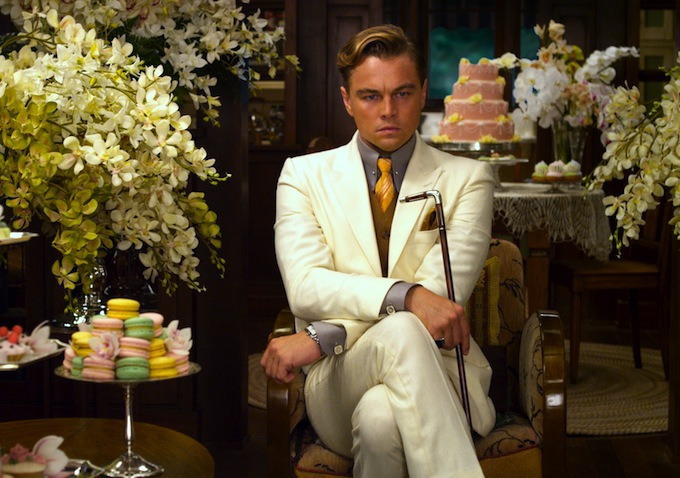
The Great Gatsby
If only all Cliff Notes were like this! I realized halfway through Baz Luhrmann's version of the novel by F. Scott Fitzgerald, that if Luhrmann and producer Jay Z are able to interest young people who don't read books in this quintessential American classic, even if that means adding a hip-hop/roaring twenties mashup soundtrack (mostly quite good) and a generous dash of vulgar glitz, so be it. But that's because the second half of this movie is so much better than the first. The first half of this spectacle is hard going, since Luhrmann seems to have made "Great Gatsby: The Rollercoaster".
The camera never stops to register anything of note, not the expressions in the actors' faces or even the busy minutiae of the production design. My heart sank at the tackiness. Everything looks like painted cardboard, cheap and vulgar, except for the costumes, particularly the men's, by Catherine Martin. Worse, everything looks like Disneyland. And everything is needlessly busy, since it is designed for 3D, a preposterous decision. I did not see the movie in 3D (go ahead, sue me), so certain gestures are too literal, like Gatsby (Leonardo DiCaprio) reaching his hand out on cue towards the water as he pines for Daisy Buchanan (Carey Mulligan). I winced and groaned at the lack of subtlety, and at some of the overblown choices, like introducing Gatsby to the strains of George Gershwin's majestic Rhapsody in Blue. There is nothing wrong with that music, but it refuses to be relegated to background noise (as Woody Allen brilliantly understood in the opening credits of Manhattan). Either you pay attention to it, or to the film. This haphazard chaos happens a couple of times with Lurhmann's sometimes clumsy assault on the senses, but then something mysterious happens. Once the story gets going, the movie settles down and gets out of the way. And what emerges is a hard, sparkling diamond of a story. A brutally sparse and elegant tale, exquisitely told by Fitzgerald's words, used to good effect, even as they are splattered across the screen, about the lunacy of American self-invention and optimism, and about the superficiality of money. It's as if the story is too powerful to let Lurhmann ruin it, and he shows some skill and restraint (of sorts) once things get dramatic.
DiCaprio brings a feral hunger to his portrayal of Jay Gatsby which completely jells with Nick's description of him as a striver. Everything is there: his trying too hard, his insecurity (a bit hammed up), the mystery that belies less of a mystique and more of a prosaic secret. He is very good (I bet he will get no respect) and he looks chiseled and dreamy in those magnificent suits. The rest of the cast is good too. Carey Mulligan tends to always be good in everything, but I thought she was too elegant for Daisy, who should be a slightly vapid airhead. Joel Edgerton and Jason Clarke play their American characters with vigor, and Isla Fisher is wasted in a small part as Myrtle. The formerly unknown Elizabeth Debicki has a star-making turn as Jordan Baker. But everybody in the background seems wrong, over the top, including Amitabh Bachchan as Meyer Wolfsheim, a Jewish prohibition gangster.
As for the preposterous idea that Nick Carraway wrote The Great Gatsby as he recovered from all that partying in a sanatorium, I found it more literal than offensive. I wish that McGuire would have shown more of Nick's crush on his cousin Daisy, and little more edge in general, since he is an outsider sharply observing the rich and the consequences of their behavior. For most of the movie he's just happy to string along with ever-widening innocent eyes. There should be more of a slow simmer to his gathering outrage. Still, this movie is much better than the pallid, boring 1974 version with Robert Redford and Mia Farrow, yet it made me wish that one day someone is going to come along and finally get it right.
May 25, 2013
Fill The Void
This surprise hit, written and directed by Rama Burshtein, takes place inside the fold of a well-to-do orthodox Jewish family in Tel Aviv and it is remarkable for being a very sympathetic, insider's view of a cloistered world. Burshtein went to film school in Israel, and then became religious, so she has the advantage of straddling two world views. This, her first feature, is self-assured and very touching. It is unheard of for an orthodox woman to write and direct a film intended for a general audience. The restrictions that the haredim, as they are called, place on what women can and cannot do are legion. So Burshtein had to use mostly non-orthodox actors, and is very brave by forging ahead with a project that the more radical members of her community may consider offensive, even as it portrays them in a very good light.
Beautiful, soulful Shira (the amazing Hadas Yaron) is 18 years old and going through the arranged marriage dating ritual. That is, parents talk amongst themselves, trying to find a good match for their marriageable kids. The kids are slowly introduced to one another in the hopes that something will spark that will lead to a happy union, or at least not to unmitigated disaster. Shira sees her first candidate at a at an arranged viewing at a supermarket, of all places. Being young and innocent, her heart flutters, despite the fact that the young dork displays no interest in her and has nowhere near the charm or intelligence that she deserves. Marriage and procreation are the foremost obsession among orthodox Jews (and I venture to say, Jews in general), and just as marriage is celebrated with great joy, its absence is pretty much the worst that could happen. Shira's friends are getting married off, and we see the ambivalent reaction of elation and dread in Shira's face when one of them delivers the good news. For the young bride's older sister it's even worse. She sheds heavy tears of sorrow when she should be happy.
Shira's pregnant older sister dies in childbirth, leaving her husband Yohai (Yiftach Klein) a widower with a baby. A wife must be found for him, even though he is not ready to remarry, and the one candidate lives in Belgium. Shira's mother cannot abide the thought of losing her grandchild, so she gets the idea, which is something that tends to happen in this community, of marrying Shira to him.
Shira is appalled. Yohai is her beloved sisters' husband, which is gross. She doesn't see him as husband material (he's actually good looking, but in his early thirties, considered too old for her). She also wants to have her own experience with someone as fresh as her, not with someone who's been around the block. But at the same time, Shira feels its her responsibility to prevent more sadness in the family, to fill the void left by her sister. She is guileless, but also quite mature. The audience may be surprised to learn that the wishes of the parties are indeed taken into account by the parents, the matchmakers and the rabbis. Nobody wants to force young people to be miserable forever, although their lack of independence and experience may be difficult to surmount later on. As negotiations ebb and flow with Yohai, she doesn't realize that he has begun to see her with loving eyes, and his feelings are hurt by her cold resolve to marry him only in order to help her family. Shira makes mistakes and has several changes of heart. It's her coming of age, not only as a woman, but as a person.
Burshtein said that she wanted the setting of the movie to be Shira's heart and she achieves this by staying very close to her, (with the help of wonderful cinematography by Asaf Sudri). There is a beautiful, funny scene where she plays accordion in the kindergarten where she works, and her troubles make her drift into a haunting melody that definitely kills the mood of the jumping toddlers around her. Burshtein sustains a wonderful tone of warm, gentle humor and melancholy and shows that there are still choices to be made by individuals, that not all is as appalling as it looks from the uncomprehending outside. Shira's middle aged aunt, for instance, covers her hair like a married woman, though she's a spinster. This is under the sage advice of the rabbi, so that people won't torture her with stares and questions. She has no arms, so why add further humiliation? By the same token, she confides in Shira that she almost got married once, to a guy who had a limp, but she didn't like him. There was a choice for her, as there is for Shira, even though it may seem very limited by our emancipated, secular standards. I despise the orthodox oppression of women and the regressive, neurotic rules they cling to that are nowhere to be found in the Bible, but it's good to know that it's not as bad as it seems. Granted, most of the characters in this movie are quite attractive, this is a wealthy family and the adults seem to be wise and sensible people. Things may be more dire in reality for members of this community that are not as blessed as this family. Still, Fill The Void is a warm, lovely film that brings us closer to a community with which we may feel we have nothing in common.
This is quite an achievement.
Subscribe to:
Posts (Atom)