Paul Thomas Anderson seems to be on a heroic quest to make serious, epic American movies. After the stark solemnity of
There Will Be Blood, comes
The Master, written and directed by the filmmaker, a big, gorgeous looking film that seems related to
There Will Be Blood in ambition and scale, but not much else. If
TWBB (based on a novel by Upton Sinclair) was about a period of effervescent enterprise in American history, a characterization of the can-do American capitalist spirit taken to an alienating extreme ("I drink your milk shake!"),
The Master seems to be about the polarities of mind versus body, rationality versus instinct, intellectuality versus feeling, mind control versus madness.
I was dumbfounded by the movie because I am unsure of the point it wants to make.
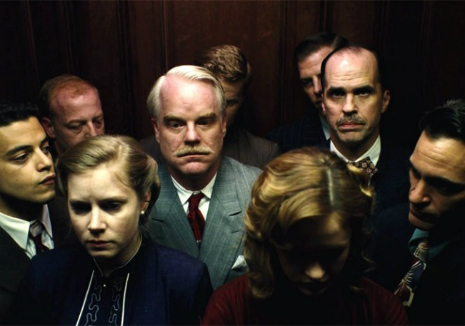
The two main characters, Lancaster Dodd (Philip Seymour Hoffman), the suave, articulate leader of a Scientology-like cult and Freddie Quell (Joaquin Phoenix), a troubled WWII combat veteran, are exact opposites in attraction and conflict. They may be fascinating as symbolic concepts on a page. As characters in a story, I'm afraid that they remain wholly intellectual constructs, despite the acting chops that both actors bring to their roles.
The Master is a long movie with a stately pace, but it does not convincingly build a coherent case for the characters. I never quite understood their motivations.
Dodd, who is an imaginative, mercurial charlatan, is intent on mind control, and is fascinated by the challenge that Freddie brings. For Freddie is a world class drunk, the kind who drinks Lysol and mixes cocktails laced with paint thinner; a man broken by war, violence and loss. He is impossible to tame. The dialectic between them is pretty clear, but it remains a dialectic, there are no big turns in either man's character. Maybe it is too conventional to expect Freddie to realize that his master is a fake, and he kind of does, but then the movie does not follow up on this. The dysfunctional pattern of abuse in their relationship repeats itself over and over again. Inexplicably, Freddie allows himself to be run ragged by Dodd's cockamamie psychological treatments and he becomes a mindless enforcer. He doesn't seem to be a fervent convert to The Cause, as Dodd calls his movement, but he uses his rage against those who think differently, acting on violent impulse alone. One can clearly see how, with enough manipulation, certain leaders can get angry young men to commit acts of violence for a cause. In fact, Dodd mildly chastises Freddie for his outbursts, when it seems that he secretly enjoys his displays of brute force on his behalf. This I can believe. What is harder to grasp is why. Why is Dodd so taken by Freddie? Sheer challenge? Does he really love him? He has a skeptical son who delivers a crucial blow to Freddie's understanding of Dodd, but Dodd does not relate to his son at all. Is Freddie the son he really wants? Why is Freddie so taken with Dodd? Dodd's ideas don't seem to really make a dent on him. He just needs a home, a fold to belong to. In time, he does doubt, but not enough. In the end, Freddie is a maddening and opaque character, who refuses to act for himself, who has no convictions. Phoenix is extremely compelling, his face gaunt and askew, and he does a heroic job of trying to keep the audience on his side, using every hambone trick in the bag to portray a rudderless, traumatized man. But is is a labored, sweaty performance. It doesn't hold up to Hoffman's much more astute portrayal of Dodd. Hoffman is on his way to becoming a giant American actor. Here he is completely believable as a charismatic leader. He achieves this by underplaying. As Dodd, he seems totally relaxed in his own skin, absolutely convinced of his grandiose mumbo jumbo, while aware that he needs to be genial and flamboyant when required, to put on a show for the troops. It is a brilliant performance. Unfortunately, Anderson has tipped the scales on the side of exaggeration and conceived Freddie as such a jumble of raw emotion, that it's never an equal fight between the characters. It would have been more subtle and surprising if Freddie's madness was less over the top. There has to be a substantial level of sociopathy to undertake cult charlatanerie. Dodd always sounds exuberantly rational, even when he is spouting ridiculous new-agey bullshit. But Freddie is extremely damaged goods. I wish Freddie showed a cunning side, a surprisingly rational edge, to be able to fight this man more equally. The fight should be between a cult leader and someone who has the ammunition to fight him; otherwise it is lopsided and fruitless.
Amy Adams is used effectively as Dodd's controlling wife. Her aw-shucks, fresh faced goodness is in full bloom, but there is something cold and ambitious in her (a bit too much a la Lady Macbeth). It's nice to see her play a meanie. Yet what motivates her other than, we assume, power? Anderson won't stoop to offer psychological detail. He is painting with grand symbolic, intellectual gestures. Dramatic opportunities are presented and then thrown away. For instance, Dodd's daughter tries to seduce Freddie, but he never uses this to defend himself from the milquetoasty accusations of her husband. Is it because he won't stoop to that? He doesn't want to hurt Dodd? On another instance, Dodd's wife reads her husband the riot act while she jerks him off in the bathroom. Perhaps this is supposed to mean that the master puppeteer is also dangling by some threads of his own, but then her threats are never brought to bear. A fantastic scene that takes place in jail, at the exact midpoint of the movie, where Freddie and Dodd are in adjacent cells, Freddie going bonkers with rage, and Dodd just standing there, seems to encapsulate what the movie is about. A conflict/attraction between someone who thinks he can control people's minds, and someone whose mind is too crazy to control. Freddie confronts Dodd and accuses him of making the shit up. You would think that this is where everything turns in the movie, but no such thing happens. Freddie goes back to the fold without explanation. There are many such dramatic scenes that, compelling and intense as they are, find no fruition later in the film.
The Master is too psychologically obtuse, and a bit of a bore.
The production design by Jack Fisk and the cinematography by Mihai Malaimare are flawless. It looks exactly like the 1950's: streamlined, straitlaced, repressed, about to explode without knowing it. I found the score by Jonny Greenwood (of Radiohead) a bit bombastic and pretentious, but the use of pop songs of the era adds much needed emotional guidance.
The Master seems to have been made as Art with a capital A, psychological clarity be damned (Anderson has always had a pretentious streak and it is in plentiful evidence here). Although
The Master has powerful moments, it feels like it's all still duking it out in Anderson's head.