Showing posts with label Ryan Gosling. Show all posts

Dec 19, 2016

La La Land


This is going to sound completely vacuous, but watching Ryan Gosling hoof and sing and fall in love and play the ivories with passion made me forget about all the problems in the world. In fact, it made me think: Aleppo and Trump are happening, but here is Ryan Gosling giving my tired old heart sheer undiluted joy. Isn't this what movies and movie stars are for?
Director Damian Chazelle (Whiplash) is a clever filmmaker, and he seems to have opted for deliberate artificiality in order to make La La Land, a musical movie, work. And work it does, emotionally. The story is about two creative people, Mia, an aspiring actress and Sebastian, an anachronistic jazz pianist, who struggle to hang on to their dignity in L.A., a sunny but brutal town when it comes to making dreams come true.
But La La Land works mainly because Emma Stone and Ryan Gosling are wonderful and delightful. They have a lovely chemistry together and are excellent apart. They are not belters or showbiz kind of performers so their naturality as they sing and dance is very affecting. They portray their characters with grit, wit and charm.
Chazelle is good with perky dialogue as well as with visual gags. The opening scene is a nod to the famous traffic jam that opens Fellini's 81/2, but also a sweet joke on the legendary gridlock of Los Angeles. The different music coming out of people's cars sets up the stage for the musical we're about to watch.  Being as they are, stuck in traffic, Mia and Sebastian do not meet cute; they meet with road rage. The spirit of this film is at once romantic and nostalgic for the effortless romance of the past, and also a little bit jaded and realistic about life. Billy Wilder would be proud.
La La Land made me think of the Great Depression and how those Busby Berkeley musicals and other light fare spirited people away from their misery (if they could afford a movie ticket). This charming film does that. It sucks you into the story of the artistic and romantic struggles of two winning losers, with pep and whimsy but without sentimentality, indeed with a clear-eyed realistic assessment of love, and a ballsy dream sequence that goes for the bittersweet because life isn't perfect.
The music by Justin Hurwitz is nice and serviceable, but not particularly memorable (the uninteresting leit motif repeated over and over is borderline annoying). Chazelle uses normal singing voices, instead of Ethel Merman-like singers, and the effect is a little shaggy, but heartfelt. Stone and Gosling are refreshingly natural singers and dancers, a much-needed antidote to the horrifying belting currently in vogue in films like Frozen. They have class.
Although the color scheme aims to evoke the technicolor musicals of yore I thought the film could look better. However, coming up with an original musical film in this day and age is a radical notion, and this fresh take on love and creative struggle is a lovely and timely gift from a talented filmmaker.

Dec 14, 2015

The Big Short


A fun, hair-raising, if rather tardy, outrage-inducing satirical romp by Adam McKay, based on Michael Lewis' book about the financial whizzes who realized that the world economy was going to tank back in 2007 due to subprime lending practices. It is a gnarly topic, but breezily explained by a very game cast. Instead of going for the full-out dramatization of a non-fiction book, McKay and co-screenwriter Charles Randolph use some fun devices to keep the story urgent. Some of the characters speak in voiceover and break the fourth wall, roping us in as accomplices. Celebrity guest stars, like Margot Robbie in a bubble bath, explain to us in almost plain English some of these incomprehensible, diabolical instruments. It's 80% exposition, but it doesn't feel like it.
All the actors deserve kudos for credibly wrapping their tongues around the deliberately impenetrable financial jargon. They are all fantastic. Christian Bale, who rarely gets the opportunity to be funny, is melancholy and awkward as Dr. Michael Burry, a t-shirt wearing renegade who managed a big fund in California, looked at mortgage defaults and decided to short that market. That is, to bet against it.
A very funny Ryan Gosling stars as an AAA asshole called Jared Vennett, a big shot at Deutsche Bank, who decides to go into the shorting business for himself, like a rogue cowboy (this kind of behavior is applauded at banks). An excellent Steve Carell plays fund manager Mark Baum, and a wonderful team of supporting players rounds up this white male saga of financial chicanery and destruction.
The story follows how different people started snooping around the securitized mortgage industry, to slowly and painfully reveal that the world would collapse on a tailspin of unregulated greed, corruption, malfeasance and corporate criminality, which not only went unpunished, but was rewarded with a trillion-dollar taxpayer bailout. The movie works the audience up into a lather of disbelief and outrage. It is fitting that it opens with a quote from Mark Twain, the father of American satire. If it were drama, it would be too bitter to swallow. But satire can hurt more than drama, and McKay is delightfully, and rightfully, incensed about it. He manages to keep the laughs and the suspense pumping while clearly explaining what happened.
It is a strange vicarious thrill to find oneself rooting for these banker guys shorting billions of dollars of toxic instruments, and waiting (hoping!) on the edge of our seats to see if they cash out. Some of them seem to have a conscience, like Baum; others like Vennett, don't. Others, like Burry, are ruled by their own strict professional compass. All of them are brilliant masters of the financial universe, and it takes them forever to figure it out. Meanwhile, the audience cannot help but be seduced by the allure of the billions of dollars bandied about in conversation. We are eavesdropping where we will never be welcome. These terrible guys are our fantasy proxies, which is rather depressing. The tension between the serious outrage and the comedy is deftly handled, but what exactly are we laughing at? We were played, and are still being played like idiots.
Together with cinematographer Barry Ackroyd, who is known for his gung-ho work on films like The Hurt Locker, Captain Phillips and United 93, McKay keeps the complicated explanation moving and stitches together collages of images of recent history with fast cuts of how rosy things looked back before 2008 and the human debris that followed: people living in tents, lines snaking around depressing job fairs.
My favorite scenes are at the local level, when Baum and his guys go to Florida to take an actual look at the housing market. It's a sweltering ghost town. Mail piles up in abandoned houses, gators loll about in brackish swimming pools. Strippers take out loans on five houses, while local banker bros brag about giving loans to people without incomes, trying to impress the horrified bankers from New York.
McKay feels the need to insert a couple of discreet but unnecessary touches of humanity. Baum is reeling from a terrible loss, which is what makes him into a crusader. We see a family lose their home and it is sad, but I don't think the movie needs these tears. It is devastating enough as it shows us how the system is made to game us; how despite endless protestation, nothing has changed. We're dupes in the biggest con on Earth. We are still living the fallout of that disaster, the government is still not regulating the banks, and banks are still creating toxic products, albeit with different names. Politicians are still at the service of Wall Street. The middle class is being strangled, and somehow poor people and immigrants, as Baum says, are blamed for everything.
Nothing to laugh at, really.

ps: Check out this unsurprisingly mean-spirited review and masterpiece of cognitive dissonance from The Wall Street Journal. It's kind of a hoot.

Apr 4, 2013

The Place Beyond The Pines


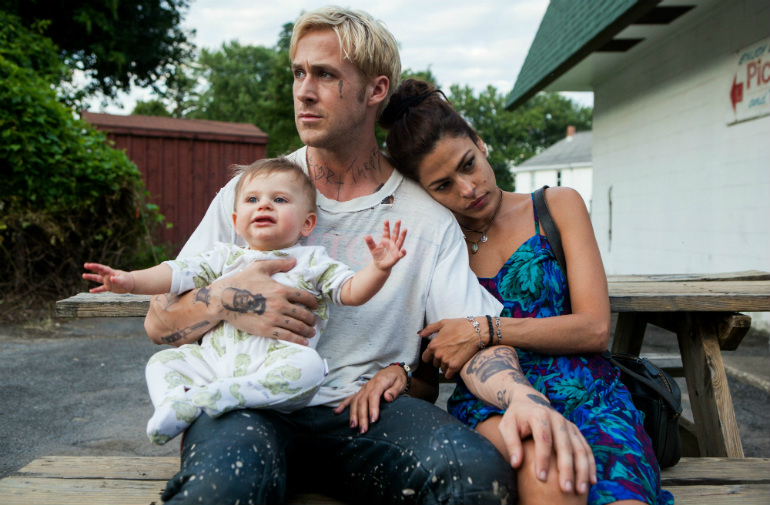
A.k.a, Schenectady, New York; according to the new drama by Derek Cianfrance (Blue Valentine), an American semi-wasteland full of missing fathers, and repressed and not so repressed violence. This long, ambitious film, about absent fathers and lonely sons, heroes and losers, is like Blue Valentine, an exercise in creating intense intimacy with the characters. The movie is comprised of three intertwined stories. Ryan Gosling plays a man called Luke, a motorcycle daredevil and inveterate loser, who aims to do right as a father but keeps screwing up. Gosling is very good at playing obstinate, almost childlike brooders. His smooth underplaying and his angelical face make his violent outbursts all the more effective. He and Eva Mendes together are a many splendored thing to behold. Mendes is incredibly sexy, but also a fine actress; like a Raquel Welch with talent.
Gosling's story comes to an end as Bradley Cooper's story begins. Unlike some of the critics I read, who cannot keep gigantic story spoilers under wraps, I won't tell you how. Cooper plays Avery Cross, a rookie cop who gets in trouble in the line of duty. As opposed to Luke, Avery has an education, a solid middle class upbringing and every chance to be a perfectly good husband and father, but it doesn't work out. He turns out to be a willingly absent father to his bully of a young son (the very mannered Emory Cohen. Somebody must have told this not untalented kid he looks like a young Marlon Brando. He's gotta stop believing it). Cooper is very good in this movie, playing a deceptively plain man who turns out to be a shark. The outlaw turns out to be more decent than the cop; the loner more home oriented than the family stalwart. One gets more satisfaction from these kind of ironies than from understanding who these people really are. Still, all the actors are fantastic, very invested in whatever it is that drives them, and this makes the movie compelling. Ray Liotta is extra perfect as a corrupt cop so efficiently nasty, he makes you want to run for your life. So is Ben Mendelsohn, as Luke's melancholy sidekick, in whom I detected a bit of a very effective man crush on Gosling (and who can blame him?).
Weaved into the topic of fathers is the theme of heroes, of decency and truth and the kind of behavior that men are supposed to teach their offspring, when they are not too busy being selfish egotists.
I have complained bitterly about the American hero fantasies that inform most commercial films, which are made mostly by men. I'm tired of the "trying to impress my absent dad" shit. Nobody ever tries to impress their moms, unless it's a comedy. I'm so over this pious macho cliché. At least Cianfrance and his co-writers are out to explore in more depth what really makes a man a father and a hero. Their answer, in short, is the one who sticks quietly around, being a decent, hardworking human being, actually caring for his family. Not the cop, not the daredevil, but the stand up guy (the wonderful and super handsome Mahershala Ali, from House of Cards).
The third act is about the teenage sons of these two men. The movie is gripping until past the midpoint. Then it becomes strained melodrama, with alarmingly unconvincing plot contrivances and grand symbolic gestures that have characters doing all kinds of unlikely things. But Cianfrance has a great  way with actors, and a desire to make the intimacy between characters and audience happen; actually, a rare feat. In lesser hands this could be a farfetched weepie, but it has a dark and probing spirit, an ominous vibe that is well worth watching.

Aug 22, 2012

Cosmopolis


A valiant failure. It's no coincidence that no novel of Don DeLillo's has ever been adapted for the screen. One of the greatest American novelists and a master of language, DeLillo's books do not lend themselves to film easily. This did not deter David Cronenberg from adapting Cosmopolis, a novel DeLillo wrote in 2003 about Eric Packer, a young master of the universe who spends all day trapped in his limo, going to get a haircut, while the world implodes around him, in no small part thanks to his predatory bets on the markets. It is symbolism in capital letters, a dark fable about the tightening chokehold of unbridled capitalism. On paper, it may look like it can be made into a film. There is enough incident, allright. Meetings, sex, even a prostrate exam happen in the car, but then there is the question of the words. Don DeLillo writes sentences that cut like black diamonds, but he doesn't write in a language that anybody who exists in reality could ever utter. Cronenberg aims to be as faithful as possible to that sharp, terse, ironic DeLillo style, but, to do that, he would need the finest actors mankind has ever offered to say these lines without sounding like pretentious automatons. The only one to emerge triumphant in this verbose ordeal is the great Paul Giamatti, firing the words like a weapon at the very end of the film. Matthieu Amalric fares very well playing a pie throwing activist and Samantha Morton hangs by a thread as some sort of financial oracle, holding the screen with the sheer conviction of her luminosity. I would have loved to see la Swinton play the part.
The rest is a disaster, mainly because Cronenberg picked Robert Pattinson, a terrible actor, to play the leading role. He is in every frame, and he tries his best, but he is flat as a board. The character is supposed to be morally and emotionally vacant, but the actor playing him cannot be vacant himself. I don't think Pattinson knows the full import of some of the lines he utters. Not because he is stupid, but because he doesn't have the depth. Ryan Gosling would have been perfect. Alas.
Even worse is Sarah Gadon, who, to judge from her performance as Packer's wife, is a totally inexperienced and untalented actress. This makes me question Cronenberg's sanity. Do not give a role with De Lillean dialogue to someone who can't act. It will bring the movie down.
As we have said before about Michael Fassbender's wooden performance in Cronenberg's A Dangerous Method, it takes a rare talent to make him act badly. The same happens here but with Juliette Binoche, an even greater actor than Fassbender, sounding wooden and fake as an art dealer. I'm starting to think that Cronenberg is just not a great director of actors. He's beginning to like very wordy literary adaptations, and his last two films seem like the life has been punched out of them by so much unwieldy dialogue. He didn't use to be this way. His movies have always exploded with messy life.
Cosmopolis is stiff but much less corseted than A Dangerous Method. Some moments of Cronenbergian pizzazz wake the audience up. The scene with Amalric is wonderful; surprising, violent and funny. So is a moment where Pattinson uses a gun. The scene with the barber (George Touliatos, excellent) has a certain power, even if most everything in this movie looks like a cheap set. I expected the look to be as polished and metallic as in Cronenberg's Crash (a pervy movie that I love), but the light is harsh, which makes the surroundings look phony (as phony as the New York of Kubrick's Eyes Wide Shut, a similar disaster, but made with much more money).
Imagine this movie had David Fincher made it. It would have been better. It sorely needs that Alpha male gloss. On the page, DeLillo's language reads like a trillion bucks: sharp, smooth, velvety, dangerous. But the movie dies trying to bring his style to life. There is not enough sharpness; not enough precision. Yet, as terribly flawed as it is, the endeavor to bring to the screen this dark fable about the collapse of our society is somehow quixotic. You cannot but root for Cronenberg, if you manage to make it to the end.

Feb 27, 2012

Oscars Postmortem 2012


As always, such an anticlimax. But, the consensus in my tiny Oscar watchfest was "they were not that terrible". Given that these are the Oscars, this is like getting an A-.
First, the dresses. Undisputed best look of the night, Rooney Mara. Best dressed, she was the only one who looked like a bona fide movie star. Second place goes to a brave and elegant Gwyneth Paltrow for pulling off a spectacular white dress. The rest was a parade of high-end schmattes, as far as I'm concerned. Put them all together in a rack and you'd think you were at a formal gown sale at Bolton's. It's a bad day for glamour when Penelope Cruz looks matronly. Where is Tilda Swinton when we need her?
I like Billy Crystal, but the shtick is not getting old, it's getting prehistoric. "Extremely Loud and Incredibly Close: that's how my relatives are watching this show". Me and the alte cackers who comprise the Academy are suckers for borscht belt humor. The rest of the world, probably not so much.
Am I crazy, or were there not enough stars? (Never enough stars). At least they had the decency not to bother with the Taylor Lautners and Ryan Reynoldses of the world. But I sorely missed me some Fassbender, some Mortensen, some Gosling, some Swinton, some Theron, some hormone blasting eye candy.  Alas.
I am still at a loss trying to understand what the hell was that commercial for Cirque Du Soleil in the middle of the proceedings. Although we are progressing as far as stopping audience abuse with musical numbers, apparently the producers cannot bear to part with random cheesiness altogether.  Who are we getting next year, Siegfried and Roy?
Obit time was long and corny, and is it me or they always use that song? There were some bad omissions: Raul Ruiz, Pedro Armendáriz Jr, Michael Gough, Michael Sarrazin, Arthur Laurents, Harry Morgan, Nicol Williamson. Instead, there was some marketing research guy in there.
Apropos of which, I thought the focus group bit by the fabulous Best in Show troupe was very funny. Focus groups are exactly like that. This was documentary in its realism. But if Hollywood thinks focus groups are so satanically moronic, as they are, why do they keep using them? Self-serving crap.
Was I moved by stars talking about how they love movies? No, because they didn't say anything specific. And who cares what Adam Sandler's influences are?  Anybody who opens a montage with a scene from Forrest Gump deserves a special circle of hell designed exclusively for them, with that scene looped at nauseam for infinity.
Emma Stone was charming. Ben Stiller should be disinvited posthaste (what was that skin color?), and as far as I'm concerned Will Ferrell and Zack G. can do no wrong. And last year's winners talking personally to the acting nominees is borderline offensive. It's like rabbis giving eulogies at funerals of dead people they never met. Horrifying. The rest is a blur.
Now, as far as the prizes: I was flummoxed by the techie love shown to Hugo, and thought it was mostly consolation prizes to Scorsese, until I read in Deadline Hollywood Daily that Hugo, which cost over $200 million to make, (and for some incomprehensible reason this obscenity is being rewarded) employed almost every tech guy in town and they all voted for it. Which explains. Because although it uses 3D and HD and ADHD, I found the look of the movie garish and applied with a heavy hand, sort of like a Parisian strumpet with a bad case of rouge. Which brings me to the one upset of the night that made me scream in horror. I was not rooting for cinematographer Emannuel Lubezki because he's a Mexican Jewish homie, but because his work in The Tree of Life is truly awesome and ravishing. Plus, he has been nominated 5 times and never won. I really thought he had it in the bag. It went to Robert Richardson's ugly, if super complex, work in Hugo. Aargh.
I had problems with many of the nominations to begin with. I would have gladly exchanged Kevin Spacey in Margin Call and Viggo Mortensen as Freud for Christopher Plummer and Nick Nolte. I would have loved to see Ryan Gosling for Ides of March or Michael Fassbender for Shame instead of Dujardin or Clooney. I would have loved to see Kristin Wiig or Charlize Theron instead of Glenn Close (who looked like the leprechaun in the Lucky Charms cereal box) or Viola Davis (yes, I've said it. I'm tired of her virtuoso weeping). 
And except for The Artist and The Tree of Life, I don't think any of the other 10 movies deserved a best of the year award. Do Moneyball and War Horse (which I haven't seen) deserve to be there, but not Bridesmaids? With bad choices to begin with, it's hard to get worked up about this.
The only awards I really cared about were that justice be made for A Separation, and for Meryl Streep, who everybody loves to hate because they cannot conceive she is as impossibly magnificent as she is. That was the one standing ovation that had actual merit in the entire show. She is the Grande Dame of American Acting if not of All Acting Ever, so back off, haters. She also does fake humility to a t.
As we have complained before, for the Oscars to have some sort of suspense, the ceremony needs to happen at the beginning of awards season and not at the end, when the outcome is almost uniformly a foregone conclusion. Let the voters not be swayed by the Golden Globes and the BAFTAs and the Golden Chickens. Let them do their homework. This would make them more exciting.
And BTW, next year, fix the sound problems. Geez.


Jan 29, 2012

On DVD: The Ides Of March


Good, dirty fun. George Clooney is a much better director than Clint Eastwood, but he gets no respect. I don't get it. He makes small, intelligent films with complicated characters. What's not to like? The Ides Of March is a zippy, nasty little movie about the queasy filth that is politics; well directed, elegant and with a splendid cast. Why doesn't Clooney get the love, I don't know. He has the good sense of hiring Paul Giamatti, Marisa Tomei, Phillip Seymour Hoffman, Jeffrey Wright, a stellar cast, all excellent. And he is not even the main character. He plays a Democratic presidential candidate named Mike Morris, but the main role belongs to Morris' strategic advisor, Stephen Meyers, played by Ryan Gosling.
Gosling is very good. He starts out as a brilliant strategist who also happens to believe in his candidate, until his heart is broken by disillusionment and betrayal, of his own doing. He makes the grave mistake of listening to the siren's call of Paul Giamatti, who is the campaign manager of Morris' adversary. Nobody in this movie is pure. Everybody makes mistakes and craves either sex, money or power. But in campaign politics mistakes of a human nature are costly because everything is a front. It's all about appearances. Everything appears to be immaculate, but everything is tainted in some way or another. In order to win, people resort to bad tactics. Integrity is impossible.
Yes, the plot points strain credulity. For those of us who would not touch politics with a ten foot pole it's hard to believe that victories are achieved through extorsion; that Ida Horowitz, a journalist for the NY Times (Tomei, encased in boxy coats, glasses and Uggs, and still sexy), would threaten to run a damaging piece in exchange for information. That a Senator from North Carolina (Jeffrey Wright) would demand to be Secretary of State in exchange for his crucial endorsement, that a simple little meeting of Gosling's with Giamatti would make the entire house of cards collapse, and more fatally, that an intern (Evan Rachel Wood, better than usual) would find a tragic end over the appearance of impropriety. But somehow, these excesses are forgivable because the movie zips along, the cast is fantastic, including Clooney, who'd be my real president in a heartbeat, and because Gosling's dilemma is very compelling. The movie works because it holds steadfast to its own theory: that politics are dirty and ruthless. It does not change its mind and decides to appease anybody's moral conscience or make the audience feel good. Stephen Meyers is an antihero who ends up getting what he wants, by losing everything that is important and not at all in the way he wanted it. Gosling convincingly transforms himself from an enthusiastic believer to a bitter, cynical man bent on revenge.  A smart, brittle film. Very enjoyable.