Showing posts with label Julianne Moore. Show all posts
Mar 2, 2015
Maps To The Stars
The evil sister to Birdman, this bitterly vicious satire by David Cronenberg, based on a novel by Bruce Wagner, is happily, and like Cronenberg's best films, a movie about human horror. Maps To The Stars is about the needy, insecure, monstrously warped egos inbred by Hollywood culture, but in contrast to the genial Birdman, which is a feel-good movie in which vanity motivates creativity, Maps To The Stars is about egos so selfish and diseased they sow nothing but destruction.
The movie is at times clunky, the story and its symbolism are heavy handed and not clearly mapped out. The script strains to organize the complicated plot, in which the central metaphor is incest. The writing (the script is adapted by Wagner from his novel) is uneven. The satire is sharp but the plot is fuzzy. Still, Cronenberg meanders down extremely dark, uncomfortable places and summons his formidable capacity to shock.
More than just a facile look at Hollywood's notorious nastiness, Maps To The Stars is like a Freudian funhouse. It's a labyrinth of selves untethered by decency, empathy or common sense, that leads back to what made them sick in the first place, a recurring nightmare. Fame + Money = Crazy. Maps To The Stars makes Birdman look like a kiddie ride at Disneyland. The ignorant filth that comes out of the mouths of teenage actors in this movie makes the hacked Sony emails sound like they were written by Emily Post.
A spectacular Julianne Moore, winner of the Best Actress prize at Cannes, plays Havana Segrand, a hilariously vapid, damaged, prematurely fading movie star. Havana is the product of a traumatic childhood, courtesy of her dead movie star mother, who she believes or fantasizes, it isn't clear which, sexually abused her as a child. This being Hollywood, a remake is being made of the movie that made her mother famous, and of course, Havana wants to play her mom like a cat chasing its tail.
A hot mess of insecurity and narcissism, Moore is pitch perfect as an emotionally tortured character who boasts the casual cruelty of the utterly self-involved, complete with perky boobs and a perfect L.A. accent. She is scarily good. Havana is not the main character in the movie, but Moore steals it, and you realize how much you miss her whenever she is not onscreen. I am kind of freaking out at the Jungian implications of the same actress playing the Alzheimer's ridden neurosurgeon of Still Alice the same year as this crazy Hollywood bimbo. In my humble opinion, she won the Oscar for the wrong movie. Those endearing journalists from the Golden Globes got it right when they nominated her for both films. Not to take anything away from her sensational work in Still Alice, but her turn as Havana Segrand is an equally brave tour de force. She goes through every feeling, genuine and fake, known to man. She is, as they say in this movie, beyond.
An excellent John Cusack plays Stafford Weiss, a wealthy self-help guru who, in true self-help guru fashion, only cares about his book tour, even as his family collapses around him. Cusack approaches the phony he plays with icily controlled glee. Stafford gives expensive and painful massages and whispers psycho-spiritual mumbo jumbo to clueless stars who confuse his shtick with therapy.
Weiss has spawned a little monster, Benjie (the creepily good Evan Bird), a Bieber-like bundle of nastiness; a rotten, entitled kid who makes millions for his incompetent parents by working in crappy sequels and sitcoms. In comes the mysterious Agatha (Mia Wasikowska, excellent, as usual) all the way from Florida, with burn scars in her face. She lands a job as Havana's personal assistant, thanks to her close Twitter "friend" Carrie Fisher, who appears as herself in a perversely funny cameo. Down this Tinseltown rabbit hole everyone is connected, not only through schmoozing, name-dropping and other, more sexual activities, but by virtue of sharing the same nightmares and stories; by virtue of the ongoing incest between the movies, the lives, rehabs and deaths of movie stars, and the starfucking of executives, wannabes and audiences.
Cronenberg pulls no punches satirizing low hanging fruit like these Hollywood types, but as a master of horror he is not content with just skewering a town that skewers everybody for a living. There is something visceral in his judgement. What to make of Benjie's mother (Olivia Williams), who both pimps out her child and lets him abuse her, refusing to set a single lousy boundary? And she is not alone. Every adult is powerless around Benjie. This kid is a cash cow, hence he can be vile to everyone.
As comical as Havana is, her life is painful, lonely, full of drugs and debasement, even as she goes on eighteen thousand dollar shopping sprees. The kids in this movie are so beyond help, it's actually shocking. Hollywood is shown to be such a den of iniquity that only violent, vengeful purification is in order. Maps To The Stars is a welcome addition to the wonderful genre of acid movies about Hollywood like Sunset Blvd., The Player, and Mulholland Drive, and if it's not quite as polished as these movies, it is deliciously disturbing.
Feb 2, 2015
Never Grow Old: The Humbling and Still Alice
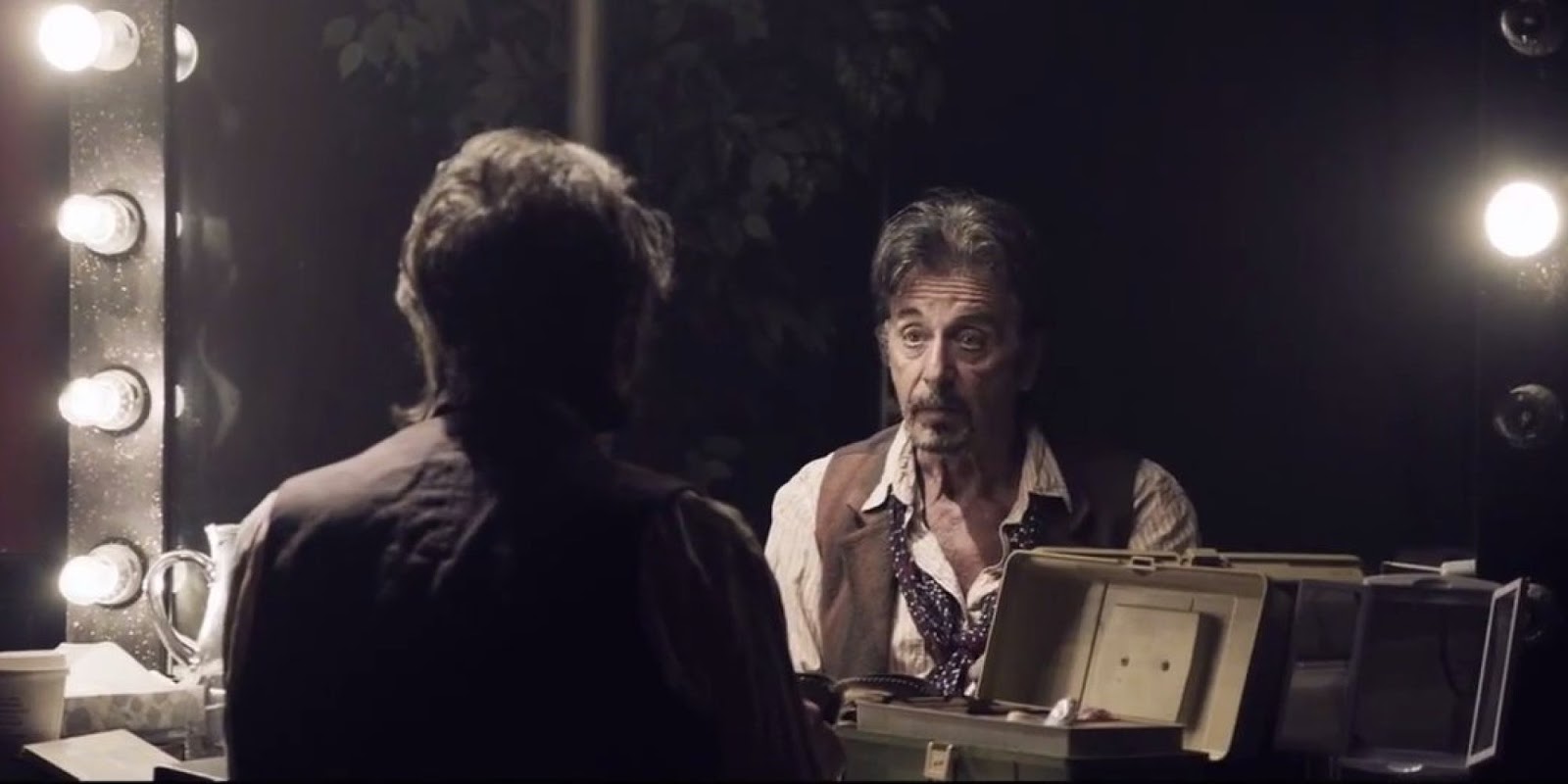
Barry Levinson's adaptation of Philip Roth's novel The Humbling, starring Al Pacino as a fading actor, is pretty good, as Roth adaptations go. Roth's mastery of language and tone is hard to translate to the screen. Levinson's very assured dark comedic tone (screenplay by Buck Henry and Michal Zebede) is closer to Roth than other recent adaptations, which tend to flatten Roth's caustic humor.
Pacino plays Simon Axler, a famous actor who is starting to lose his gifts. He is aging. He can't remember lines. He has lost his craft, the only thing he ever had. He sacrificed everything for acting, had no family and, after a blackout on stage, he finds himself old, alone and panicking, wishing for death. He has an enthusiastic if clueless agent, (Charles Grodin), and a shrink via Skype, (Dylan Baker).
Enter Pegeen, (Greta Gerwig), daughter of old actor friends, who has been harboring a childhood crush on him way past its expiration date. If it weren't for the fact that he is famous, why would she want to be with him? He is some kind of prize. That creaks.
Axler does not all of a sudden get a rejuvenating second wind. This is Philip Roth, not wishful thinking. What he gets is ideas, and fantasies, and reveries all jumbled along with reality. He also gets back pain. And other people's neuroses.
The movie very deftly makes us feel as unmoored as he is, not necessarily knowing if things happen or they are in his head. With this prickly woman comes a whole bunch of trouble. Pegeen is quite unsympathetic, which should come as no surprise, since Roth is not particularly sweet to women. She goes in and out of relationships and sexual preferences, something that Axler is incapable of fathoming. Gerwig tries to make her egocentrism interesting, but she has no empathy for anyone and deserves none.
I could not help but notice that all the women in this man's life are pests. A crazy loon (Nina Arianda) he meets at a private mental clinic wants him to kill her husband, and Pegeen's jilted lover (Kyra Sedgwick) stalks him. Pegeen's own mother, (Dianne Wiest), wants him to lay off her daughter. Poor Simon Axler, who doesn't seem to ever have done anything to deserve these furies. Still, somehow all these incomprehensible women reflect more on Axler's own bewilderment, his being completely out of touch with people, than on their own neediness.
Like Meryl Streep, Pacino is one of those astounding hams who are mostly something to behold. Here he is hammy on occasion, but not completely over the top. He has many fantastic moments and allows himself to look, feel, and sound decrepit. We see Axler only in his moments of vulnerability and it would have been interesting to get a glimpse of the mastery he lost, of his craft and life, yet as the title clearly explains, this is a movie about the slide into humiliation that is aging. In this case, it's a ruthless, unrestrained downfall.
I've always loved Barry Levinson's movies. He has a wonderful touch for comedy tinged with darkness. I also love movies that are not afraid to laugh at death and despair. Pacino is touching, but a bit too vulnerable. He is even better when he is funny. There is a hilarious scene involving painkillers in a veterinarian clinic. The excellent cast does the material ample justice. For a movie about death and decrepitude, The Humbling is quite vital. It made me think that we rarely see older people in movies. They play presidents, God or grandparents here and there, but they rarely exist as protagonists within the screen. Movies like Nebraska, Amour and The Humbling are necessary, wonderful anomalies in a world that is indifferent to old age.
Still Alice is also about diminishing capabilities. In this case, Alice is a 50 year-old woman who finds out she has early Alzheimer's disease. As played by Julianne Moore, she is a vibrant and capable neurolinguist. That this should happen to her is supposed to be either particularly ironic or terrible, but since she is smart and has a supportive family, a beautiful brownstone uptown, and a house by the sea, she has more financial and intellectual resources to cope with this devastating disease than most people. Alice is very resourceful and hands on, and searches for the truth with a vengeance. I think most people are too out of their depth when confronted by this illness to take charge as she does.
Moore is fantastic. She is clearly lost inside her mind, she runs through the gamut of Alice's feelings, including rage, shame, lack of affect, and she really seems like two different people once she starts losing her mind. She acts with authenticity, subtlety and grace. But the movie feels oddly clinical. There is no sense of the chaos I imagine visits families when this happens. Alec Baldwin plays her loving but distant husband, and Kristen Stewart her youngest daughter, but either these people are a little chilly, or the movie, afraid of sentimentality, works too hard to keep strong emotions at arm's length. Julianne Moore summons plenty of tears with her lovely performance, but the movie seems too neatly packaged for such a messy, difficult illness.
May 6, 2013
What Maisie Knew
An affecting modern adaptation of the novel by Henry James, this is a well directed movie by David Siegel and Scott McGehee, who get good performances from a solid cast, and particularly from the remarkable 6 year-old Onata Aprile, as Maisie. She is natural and unspoiled by too much training, and she is wonderful.
We see everything through Maisie's point of view as her parents, Susannah and Beale (Julianne Moore and Steve Coogan), divorce and then use her as a pawn for their petty power struggles, trying to each possess custody while being utterly inattentive and insensitive to the child.
In a fit of pique, and in order to gain custody, both parents instantly marry partners much younger and much more decent than them. Then they proceed to foist the little girl on them without compunction as they pursue their selfish business elsewhere. Luckily for Maisie, these two (Joanna Vanderham and Alexander Skarsgård) are kind and sensible souls, but even so, the feeling of a void left by parents who protest their love but do not show it, is tough going. It is increasingly horrifying to see Maisie bouncing from one place to the other, with the parents never around.
That Maisie takes abandonment in such good stride raises the question of verisimilitude, since children don't tend to take to parental neglect well. I expected Maisie to act out at some point, as children under such circumstances do. But this Maisie is poised with an innocence tempered by her own sense of knowing, and a steady will to survive moment by moment which precludes her from the tantrums and outbursts her parents are prone to. She behaves with far more composure than her monstrously egotistical parents, well-to-do people one never understands what brought them together, except the laws of attraction between assholes.
Julianne Moore plays a ferociously unlikable rock star. Manipulative, needy, self-absorbed, she still finds ways to empathize with Susannah by inflecting her with a modicum of self-awareness that she thinks is enough to give her a pass as a mother. An "I know I'm bad, so I'm excused", kind of thing. She has one redeeming scene, in which she finally and for the first time abdicates her own desires for the sake of her child. Steve Coogan plays Beale as the kind of hyper-articulate wit who deflects everything with lame attempts at humor, but who can't commit to any responsibility which is not to himself first. These people have feelings, but they come second to their own gargantuan needs.
The movie is shot from the point of view of a child who hears and sees things she may not completely understand, but who knows, instinctively, what they mean for her. The audience has to fill in the blanks just as she does, except we have more tools at our disposal to understand what kind of parents she has. She's blown around like a leaf in the wind and one keeps hoping she will not be torn to pieces. Maisie turns out to be a resilient little girl, which is about as happy an ending as a story like this can muster.
What Maisie Knew is handled with great tenderness, without much sentimentality. It is quietly devastating.
Subscribe to:
Posts (Atom)