Showing posts with label Kristen Stewart. Show all posts

Aug 1, 2016

Café Society


To be honest, the only reason that compelled me to see the latest Woody Allen film is that the cinematographer is Vittorio Storaro. His masterly touch certainly takes it to a higher level. His images are creamy. Some are breathtaking, like a shot of two lovers on the beach. He is beautifully abetted by the production design of the great Santo Loquasto, a longtime Allen collaborator.
So what about the movie, you might ask. Well, it's classic late-period Allen, skimpy on characters and plot, and dusted lightly with ancient jokes. Still, Café Society is not as slapdash as some of his recent outings. It is imbued with a feeling of nostalgia for the 1930's, a time when women were glamorous, nightclubs were swanky and popular music was masterful (as usual, the old standards soundtrack is delightful). Café Society is about the loss of first love; a bittersweet look at the impossibility of everlasting romance.
It is also a movie about different kinds of Jews. There are working class Jews, communist Jews, Hollywood Jews, and gangster Jews, all in one family. Allen has genuine warmth for this neurotic clan. This loving nostalgia and a good cast make this movie enjoyable.
Jesse Eisenberg plays Bobby Dorfman, a young man from the Bronx who moves to Los Angeles in search of a job. Unlike many actors who have tried and failed, Eisenberg refuses to imitate Allen's nerdy shtick. He is a canny actor, but it would be nice if he toned down that neurotic energy and cerebral edge of his. Still, he is effective as the fish out of water in glamorous Hollywood who gets a job at his uncle Phil's agency. Phil Stone (Steve Carell) is flashy, rich, and as a powerful agent, namedrops stars with panache. After much pleading, Bobby starts running errands for him and falls in love with his secretary, Vonnie, played with melancholy poise by Kristen Stewart. I didn't take Stewart seriously when she was younger and eternally pouty, but she has found her stride and here she is mesmerizing. Allen himself provides a narration that is unessential, but which aids in the feeling of longing for the past. The rest of the characters seem to have been imported from Annie Hall. The fabulous Jeannie Berlin plays Bobby's mom, and Corey Stoll plays his gangster brother, wasted without a part and saddled with an unnecessary wig (but I'll take him whenever and however I can get him). Blake Lively plays another Veronica, the other "shiksa" goddess for whom Bobby ends up falling. I wonder if the multiple Veronicas are Allen's homage to Kristof Kieslowski's The Double Life Of Veronique.
The plot is at once simplistic and convoluted and it surprises no one, but the palpable feeling of ruefulness, of losing your love to lesser but richer prospects, of the useless yearning for what could have been, is moving. This movie has more feeling than most of Allen's recent films. He has an opportunity to dwell on the uneasy combination of Hollywood glamour and bickering striving Jews, of Jews straddling between their family traditions and making it in the world, but Allen is too lazy to stitch these strands together insightfully. For a far more profound and devastating look at this topic, I heartily recommend Indignation, based on the novel by Phillip Roth, also playing.
Storaro's magic and that lovely sense of loss are about the only thing that works for Café Society. The jokes feel ancient, and some of the attitudes, like a cruel, uncomfortable scene between Bobby and a hooker are way past their expiration date.  I am also nostalgic for legendary swanky nightclubs that I never knew, wonderful popular music, and people dressing up to go out, but not for the kind of casual, rancid misogyny that is ever present in Allen's films.  He is not one with the times.

Feb 2, 2015

Never Grow Old: The Humbling and Still Alice


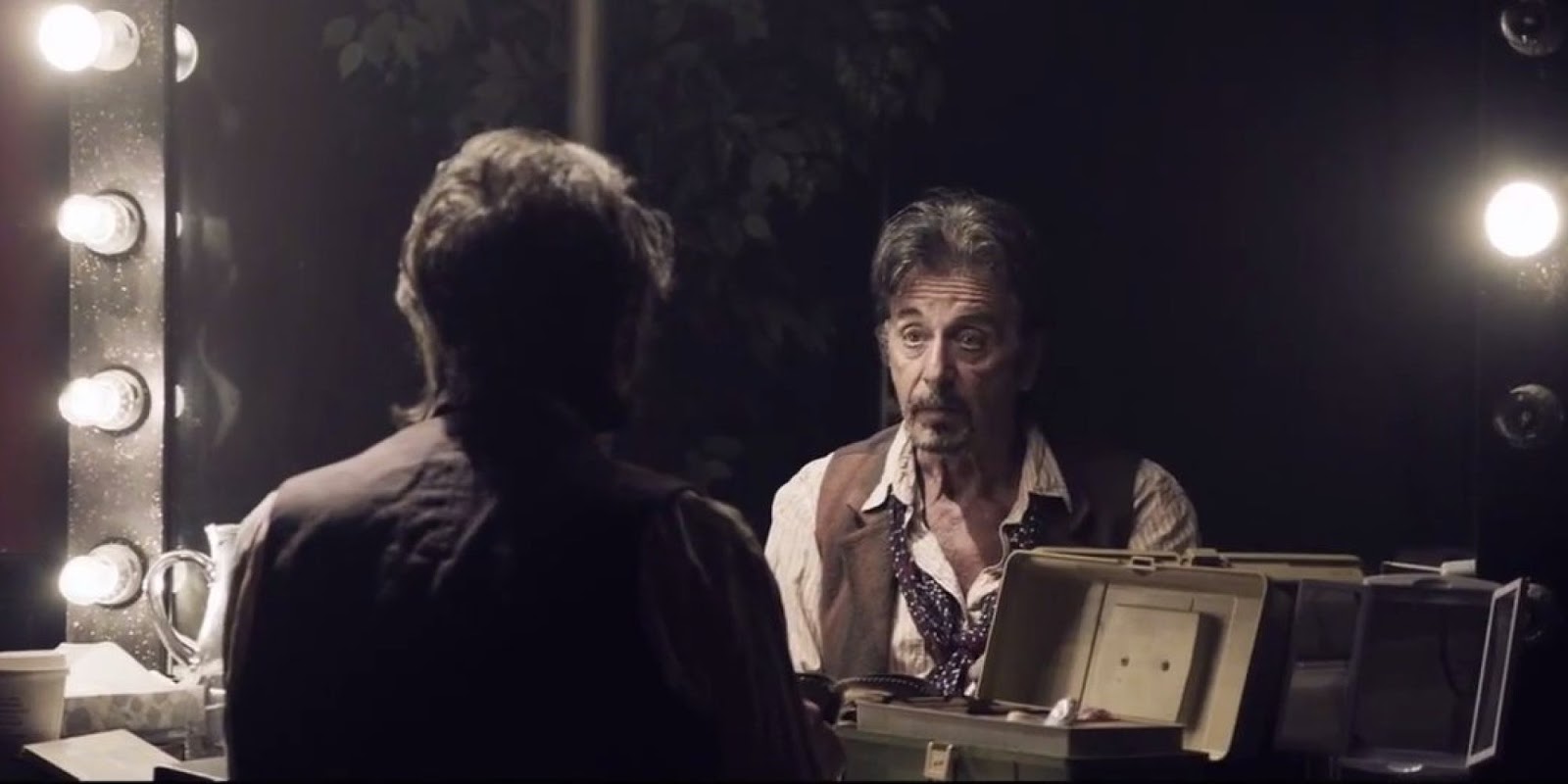
Barry Levinson's adaptation of Philip Roth's novel The Humbling, starring Al Pacino as a fading actor, is pretty good, as Roth adaptations go. Roth's mastery of language and tone is hard to translate to the screen. Levinson's very assured dark comedic tone (screenplay by Buck Henry and Michal Zebede) is closer to Roth than other recent adaptations, which tend to flatten Roth's caustic humor.
Pacino plays Simon Axler, a famous actor who is starting to lose his gifts. He is aging. He can't remember lines. He has lost his craft, the only thing he ever had. He sacrificed everything for acting, had no family and, after a blackout on stage, he finds himself old, alone and panicking, wishing for death. He has an enthusiastic if clueless agent, (Charles Grodin), and a shrink via Skype, (Dylan Baker).
Enter Pegeen, (Greta Gerwig), daughter of old actor friends, who has been harboring a childhood crush on him way past its expiration date. If it weren't for the fact that he is famous, why would she want to be with him? He is some kind of prize. That creaks.
Axler does not all of a sudden get a rejuvenating second wind. This is Philip Roth, not wishful thinking. What he gets is ideas, and fantasies, and reveries all jumbled along with reality. He also gets back pain. And other people's neuroses.
The movie very deftly makes us feel as unmoored as he is, not necessarily knowing if things happen or they are in his head. With this prickly woman comes a whole bunch of trouble. Pegeen is quite unsympathetic, which should come as no surprise, since Roth is not particularly sweet to women. She goes in and out of relationships and sexual preferences, something that Axler is incapable of fathoming. Gerwig tries to make her egocentrism interesting, but she has no empathy for anyone and deserves none.
I could not help but notice that all the women in this man's life are pests. A crazy loon (Nina Arianda) he meets at a private mental clinic wants him to kill her husband, and Pegeen's jilted lover (Kyra Sedgwick) stalks him. Pegeen's own mother, (Dianne Wiest), wants him to lay off her daughter. Poor Simon Axler, who doesn't seem to ever have done anything to deserve these furies. Still, somehow all these incomprehensible women reflect more on Axler's own bewilderment, his being completely out of touch with people, than on their own neediness.
Like Meryl Streep, Pacino is one of those astounding hams who are mostly something to behold. Here he is hammy on occasion, but not completely over the top. He has many fantastic moments and allows himself to look, feel, and sound decrepit. We see Axler only in his moments of vulnerability and it would have been interesting to get a glimpse of the mastery he lost,  of his craft and life, yet as the title clearly explains, this is a movie about the slide into humiliation that is aging. In this case, it's a ruthless, unrestrained downfall.
I've always loved Barry Levinson's movies. He has a wonderful touch for comedy tinged with darkness. I also love movies that are not afraid to laugh at death and despair. Pacino is touching, but a bit too vulnerable. He is even better when he is funny. There is a hilarious scene involving painkillers in a veterinarian clinic. The excellent cast does the material ample justice. For a movie about death and decrepitude, The Humbling is quite vital. It made me think that we rarely see older people in movies. They play presidents, God or grandparents here and there, but they rarely exist as protagonists within the screen. Movies like Nebraska, Amour and The Humbling are necessary, wonderful anomalies in a world that is indifferent to old age.


Still Alice is also about diminishing capabilities. In this case, Alice is a 50 year-old woman who finds out she has early Alzheimer's disease. As played by Julianne Moore, she is a vibrant and capable neurolinguist. That this should happen to her is supposed to be either particularly ironic or terrible, but since she is smart and has a supportive family, a beautiful brownstone uptown, and a house by the sea, she has more financial and intellectual resources to cope with this devastating disease than most people. Alice is very resourceful and hands on, and searches for the truth with a vengeance.  I think most people are too out of their depth when confronted by this illness to take charge as she does.
Moore is fantastic. She is clearly lost inside her mind, she runs through the gamut of Alice's feelings, including rage, shame, lack of affect, and she really seems like two different people once she starts losing her mind. She acts with authenticity, subtlety and grace. But the movie feels oddly clinical. There is no sense of the chaos I imagine visits families when this happens. Alec Baldwin plays her loving but distant husband, and Kristen Stewart her youngest daughter, but either these people are a little chilly, or the movie, afraid of sentimentality, works too hard to keep strong emotions at arm's length. Julianne Moore summons plenty of tears with her lovely performance, but the movie seems too neatly packaged for such a messy, difficult illness.